
Reading time: 4 minutes
Key takeaways
- Industrial laundry wastewater contains microfibres, microplastics and other residues.
- Studies show that individual laundries can account for a substantial share of the microplastic load entering a wastewater treatment plant.
- Filters and membranes can already capture microfibres. However, this produces a concentrated residue that requires further treatment.
- The EU-funded REWASH project is investigating how microplastics can be broken down and converted into bio-based chemicals and bioactive compounds.
- An industrial recovery process has yet to be demonstrated: REWASH is initially developing a prototype for validation in the laboratory or under controlled conditions.
What has primarily been seen as a burden on waterways and wastewater treatment plants could take on a new role: as a source of raw materials. Some filtration technologies already capture microfibres. Projects such as REWASH are investigating how microplastics can be converted into valuable feedstocks. This is waste to value.
It starts in the industrial laundry
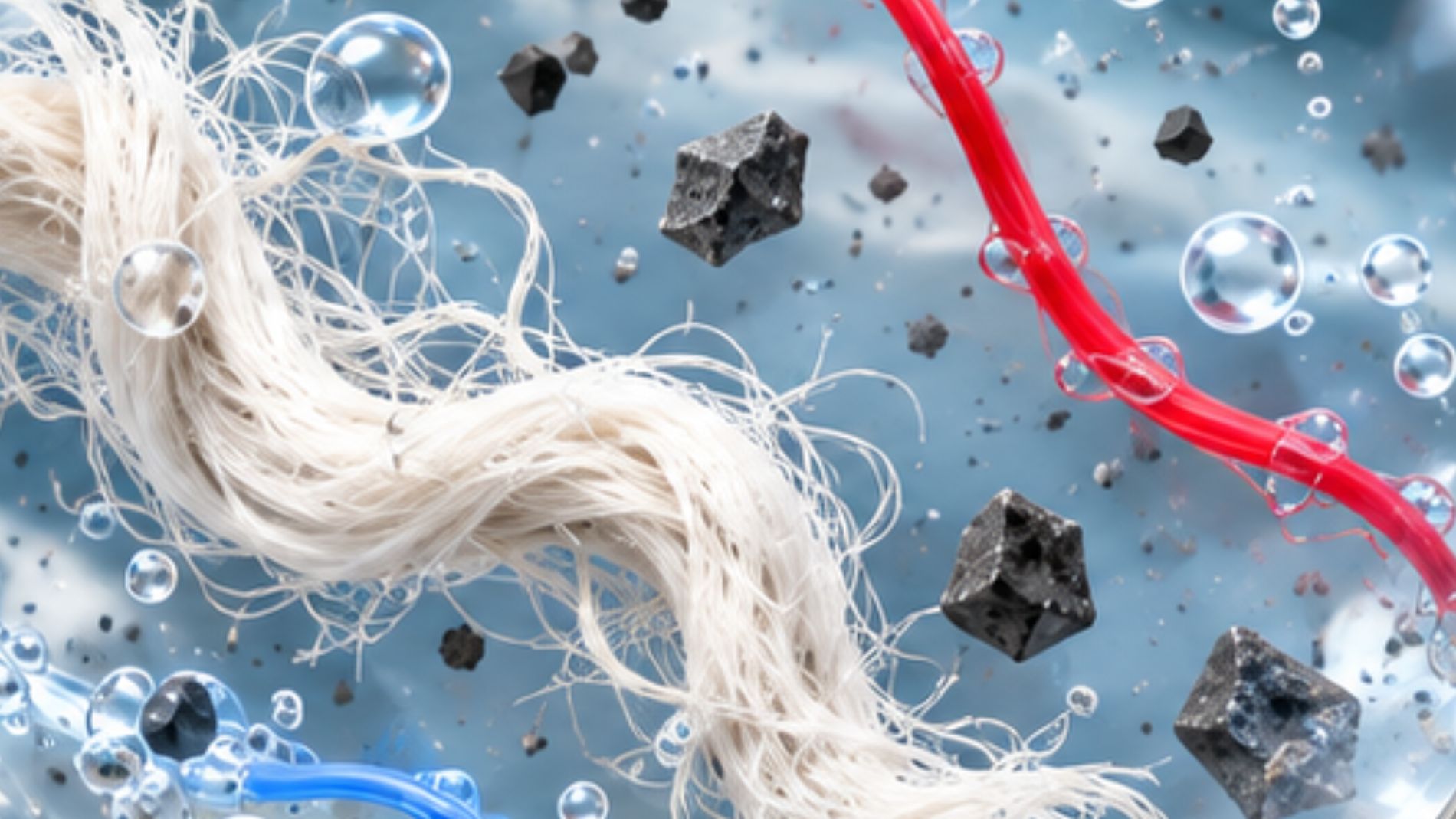
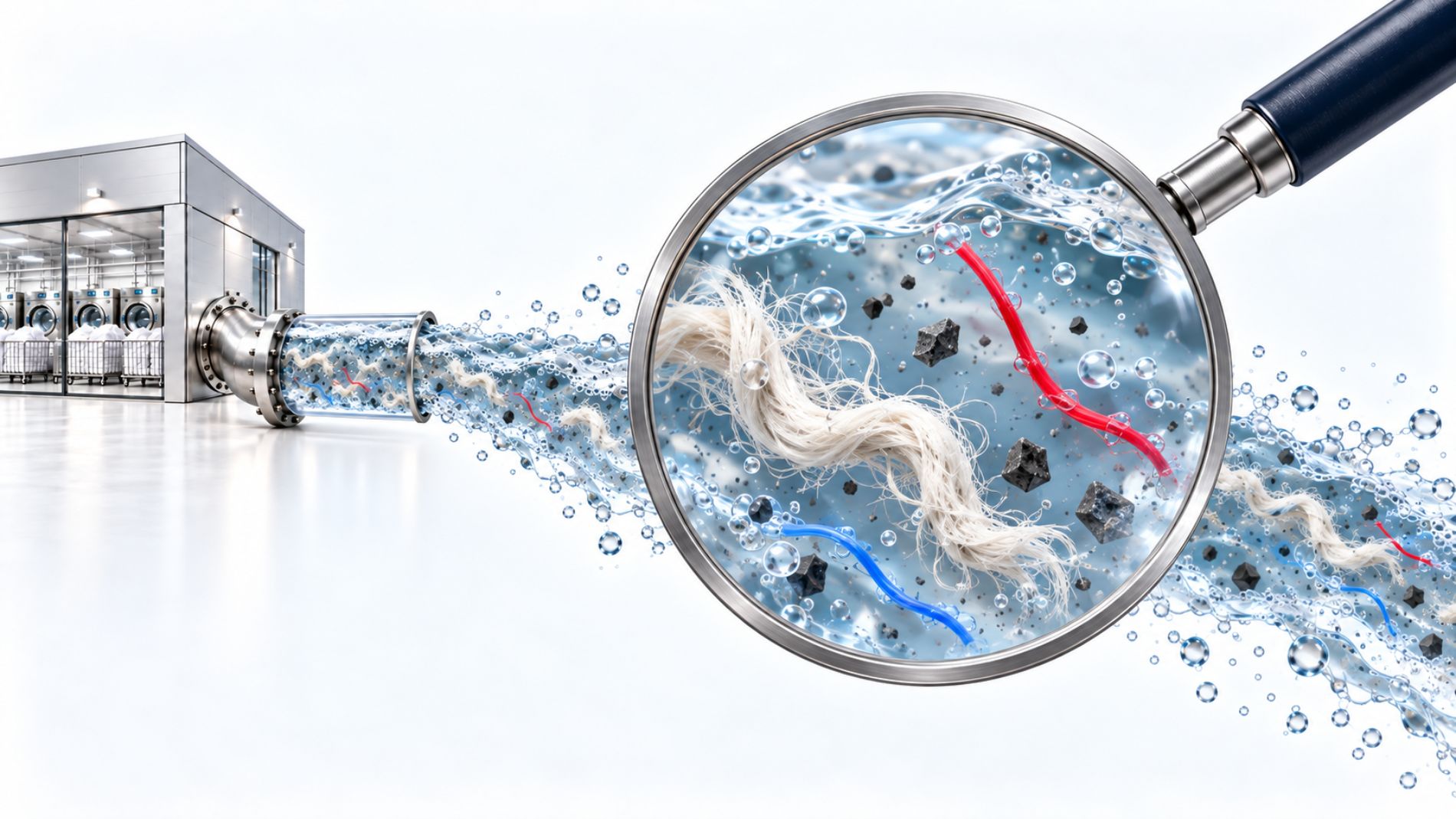
An everyday process on an industrial scale: sorting, washing, rinsing and preparing textiles for use. Whether serving restaurants, hotels or hospitals, these laundries operate in shifts. Yet we often see only the clean laundry, overlooking the considerable volumes of contaminated water produced along the way. This water contains detergents, fats, dirt particles and fibres released from textiles during washing. Alongside natural fibres such as cotton and wool, it also contains synthetic fibres such as polyester and polyamide. These enter the water cycle as microplastics.
Yet what has primarily been seen as a burden on waterways and wastewater treatment plants could take on an entirely new role: as a source of raw materials.
The invisible load: What does the wastewater actually contain?
Studies of industrial laundries reveal the scale of the problem. A 2025 study in Copenhagen, Denmark, analysed wastewater from a hospital laundry and found 1.4 million microplastic particles per litre. This was a striking finding, but it cannot be generalised, as textiles, processes, water consumption and sampling methods vary. A Dutch study (2025) highlights the substantial contribution individual laundries can make. According to its calculations, a single industrial laundry accounted for 13 per cent of the total microplastic load entering a wastewater treatment plant. Although at least 99.8 per cent of the detected fibres and particles larger than 50 micrometres can be removed during treatment, the remaining concentration can still amount to substantial particle numbers because of the enormous volumes of water involved.
The reality check: What already works today?
Mechanical filters and membranes can already separate microfibres from wastewater. Drum filters capture larger particles, while microfiltration and ultrafiltration use membranes to remove smaller constituents from the water.
In 2026, a research team investigated ceramic microfiltration in a pilot trial. More than 97 per cent of the detected microplastic fibres were consistently removed. The researchers also assessed the water quality to determine whether reuse would be feasible. Filtration initially means separation. Nothing disappears; instead, it is collected as a concentrated residue that requires disposal or further processing. However, deposits reduce membrane performance over time, making regular cleaning necessary. This is where chemical, biological, oxidative and photocatalytic processes become relevant. The most suitable combination for laundries depends on the wastewater and the intended outcome. This is where projects such as REWASH come in.
REWASH: From pollutant to valuable resource
The European Union is supporting the project with around €3.38 million. Four partners from Spain, Slovenia and Portugal are developing a modular system designed to remove microplastics and microfibres and convert their constituent parts into high-value products. The project began on 1 October 2026. The research concept combines several stages. First, photoelectrochemical processes (PEC) are used to break down microplastic particles and fibres. Specially developed bacterial communities (SynComs) then convert the resulting breakdown products into bio-based chemicals and bioactive compounds. An integrated bioelectrochemical system (BES) is intended to remove remaining substances from the wastewater, contributing to both water purification and nutrient recovery. The official project description does not name specific molecules, chemical formulae or products. It therefore remains unclear exactly which substances REWASH intends to produce.
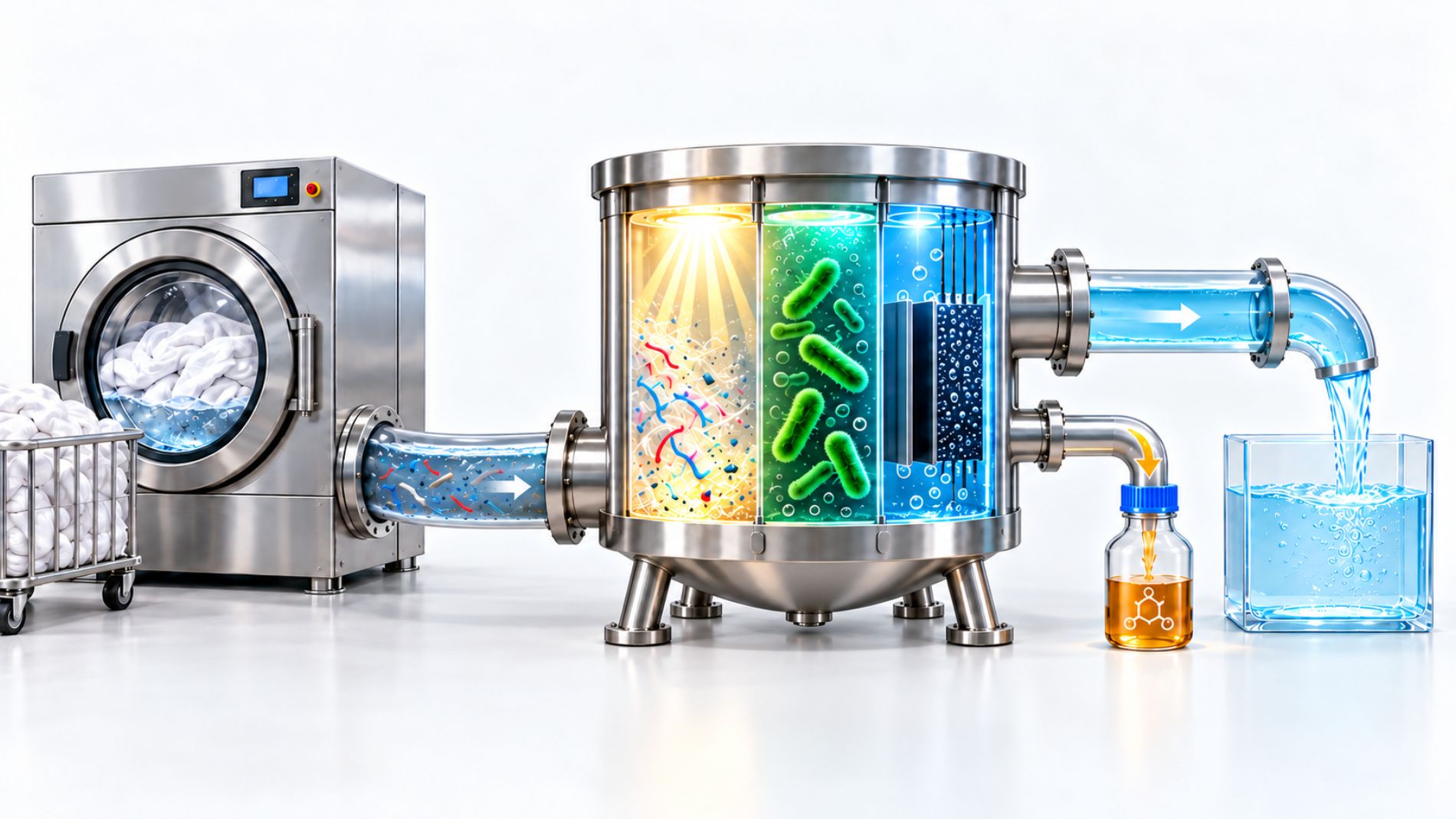
This approach differs from conventional textile recycling. Rather than turning an old fibre directly into a new one, the aim is to convert its chemical constituents into other products. The focus is on using the fibre’s underlying chemical structure rather than preserving its material.
For now, this remains an ambition rather than industrial proof of a viable recovery process. The project runs until September 2030. During this time, REWASH plans to develop a working prototype at technology readiness level 4 (TRL 4). This means validation in the laboratory or under controlled conditions. If successful, the approach could become highly relevant to industrial laundries in the future.
When does wastewater become a raw material?
Whether the waste-to-value concept succeeds and wastewater becomes a source of raw materials depends on more than breakdown performance alone. Researchers need to establish which breakdown products are formed and whether they can be reliably converted. The technology must handle real wastewater, whose composition changes with every wash cycle. Energy and chemical consumption, operational demands and costs also need to be considered. The environmental performance must stand up to scrutiny: a high microplastic removal rate offers little benefit if it requires disproportionate amounts of energy or produces harmful by-products.
A substance only becomes a useful raw material once its quality has been established, it can be used safely and there is a buyer for it. For the textile care industry, projects like these signal a potential shift in perspective: a wastewater problem could become a source of raw materials – and an environmental burden could become a contribution to the circular economy.