Reading time: 6 minutes
Key takeaways
- A shared language for textile care: Developed by GINETEX, care symbols communicate care instructions across language barriers.
- Clear treatment limits: Care labels specify the maximum permitted treatment for washing, bleaching, drying, ironing and professional cleaning.
- International standards: The symbols are defined in ISO 3758 and supported by GINETEX’s technical guidelines.
- Requirements vary by country: Care labelling is voluntary in some countries and mandatory in others. Use of the GINETEX symbols requires the appropriate rights.
- Responsibility lies with suppliers: Clothing and textile companies are responsible for providing correct care information on the products they label and sell.
- New symbols take time: New care processes must first be assessed against technical standards before they can be assigned an existing or newly developed symbol.
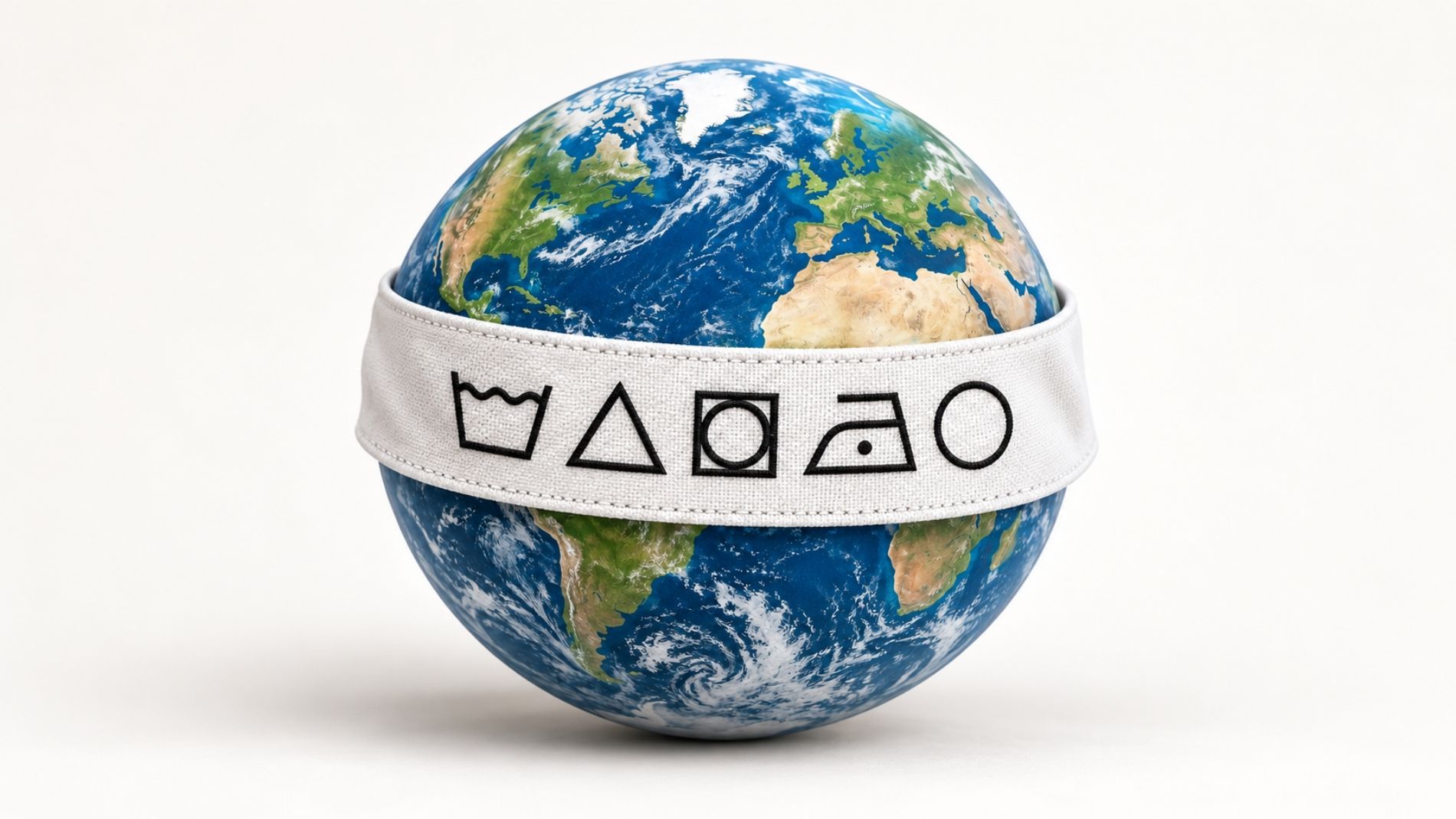
When mayonnaise misses the chips and lands on a jacket, tomato sauce splashes onto a chef’s apron or an unpleasant odour clings to your clothes, it is time to put them in the washing machine. To make sure the cleaning process goes smoothly, however, it is worth checking the care label first. The label sewn into the garment tells you whether it can be washed at all and, if so, at what temperature; whether bleaching is permitted; how it should be dried; or whether it needs to be taken to a professional cleaner. What makes care labels special is that their clear symbols can be understood around the world without the need for many words. That is why they are used in many countries. Petra Bleibohm, Deputy Chair of GINETEX GERMANY (Cologne), explains the story behind the stylised wash tub, iron and other symbols.
Who invented the care symbols, and why?
The system was developed by the international GINETEX organisation, founded in Paris in 1963. Its aim was to provide information on textile care through internationally recognised symbols that did not depend on language. This was intended to avoid having to translate care instructions into the language of every market where a product was sold. The initiative succeeded. GINETEX gradually developed symbols for the different care processes, registered them around the world and ensures that they remain technically up to date. Since their introduction, the GINETEX care symbols have achieved widespread international use: many countries use them voluntarily, while others have made them mandatory. Only two countries have completely different care-labelling systems: South Korea and the United States.
Who manages the care symbols?
The international GINETEX organisation owns the trademarks for the care symbols. It is made up of national GINETEX members in 20 so-called GINETEX countries. Their offices act as points of contact in their respective countries. They inform manufacturers, retailers, sales staff and consumers about correct, up-to-date care labelling for textiles. They also answer questions from their members, interested companies and consumers. In addition, they check whether companies have the rights to use the symbols and ensure that GINETEX requirements are met.
How is the use of the protected care symbols regulated?
The labelling of textile products with care instructions is governed by international agreements under the GINETEX framework. GINETEX has drawn up technical guidelines for this purpose. The symbols are also included in the international standard EN ISO 3758, Textiles — Care labelling code using symbols. This means that uniform rules have been established for using the symbols.
Are the care symbols legally binding?
This varies from country to country. Care labelling is voluntary in Germany, as it is in other EU and GINETEX countries. However, anyone using the GINETEX care symbols must have the right to use these trademark-protected symbols, and the care labelling must comply with GINETEX’s technical guidelines. Many countries have also enshrined the care symbols in law to protect consumers; Austria is one example.
How have uniform care symbols been established internationally?
One important factor is the GINETEX organisation, which more and more countries are joining. Japan, for example, became a GINETEX country in 2016. Before that, it had a completely different care-labelling system. The international standard ISO 3758, Textiles — Care labelling code using symbols, which applies worldwide, has also helped establish a uniform system of textile care labelling.
New care processes are being developed from time to time, and existing care symbols may not cover them. Examples include wet cleaning and dry cleaning with modern solvents. Who decides whether new care symbols are needed for such processes? How is a new symbol introduced?
Care symbols are technical symbols, which means they are defined by the technical standards behind them. If GINETEX is to include a new solvent, it must first be assessed and classified under a standard. It is then decided whether it fits an existing care symbol or whether a new one needs to be created. This is a lengthy process, and assigning a care symbol comes at the very end.
How is a new care symbol communicated to the textile care industry? How do laundries and dry cleaners learn how to treat an item bearing a new symbol?
GINETEX informs the clothing and textile industries about developments. It works like a chain reaction: many stakeholders, including the press, pick up the news and share it. Textile care associations are also affiliated with GINETEX and inform their members directly. Textile care processes are set out in standards. These explain what the different care symbols mean and how textiles should be treated. And because the symbols have been in use for so long, textile care professionals can also draw on a wealth of experience.
Who is responsible for adding care labels to textiles?
The clothing and textile companies that label and sell the products are responsible for ensuring that the care information is correct. They designed the garment, know all its components and know how it should be cared for. The label therefore states the maximum treatment the item can withstand. If the item is treated in accordance with those instructions, it should not be damaged during care.
How should textiles and garments intended exclusively for rental by textile service companies be labelled? Do they have to carry a care label?
The legal requirements are the same as for everyday clothing. Care labelling is mandatory in some countries and voluntary in others. In practice, however, care labels are commonly used. Rental textile agreements between the parties also generally set out whether care labelling is required.
Do you expect any new care symbols in the near future, for example for cleaning with supercritical or liquid carbon dioxide?
No changes are currently expected, but you never know…