
Reading time: 4 minutes
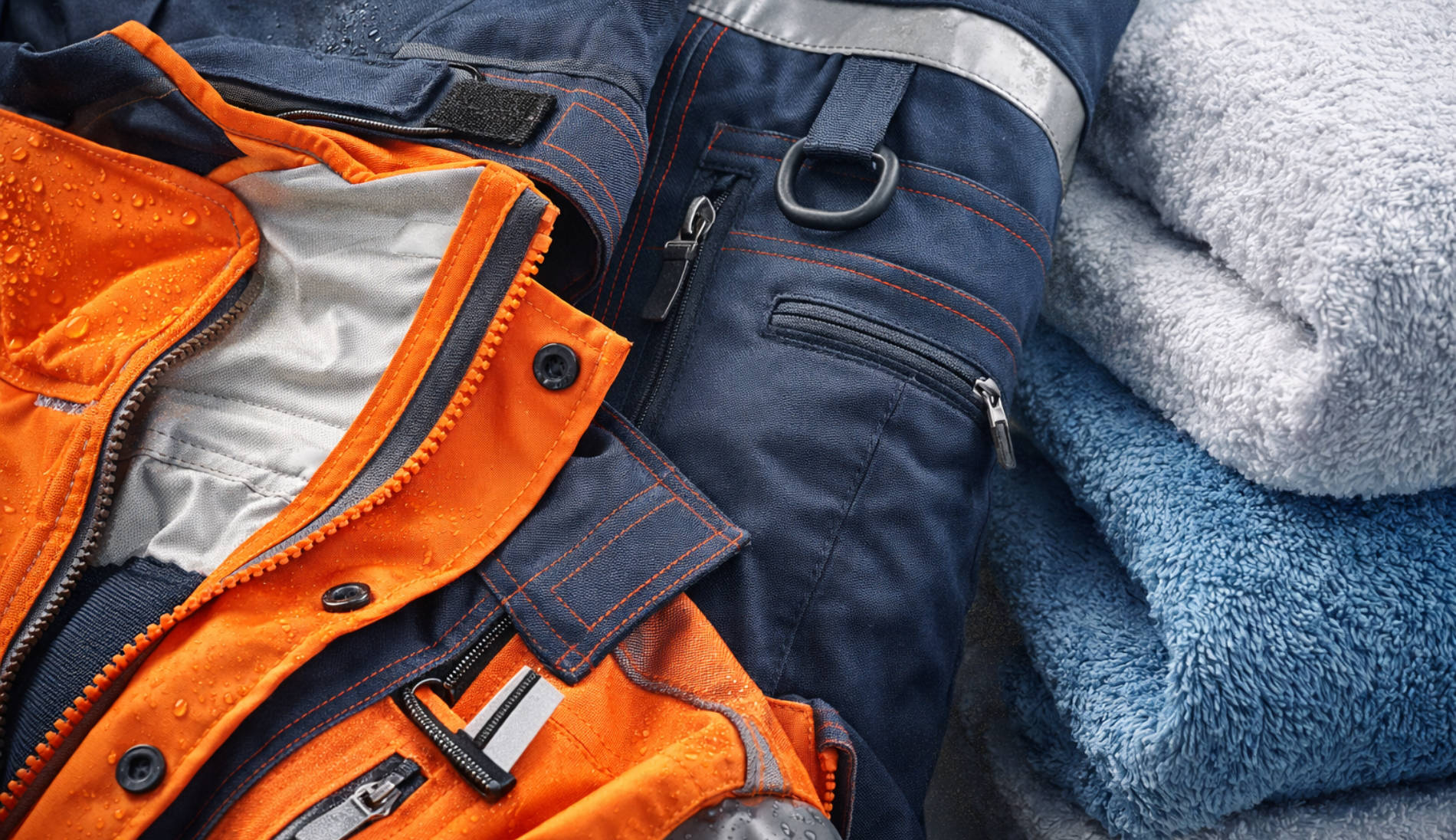
In the textile care industry there is a – admittedly not entirely grammatically correct – proverbial saying: the dryer is the textile’s death. In view of the consequential damage caused by overdried goods, this observation repeatedly proves to be true. Cotton fibres become brittle and turn grey when all moisture is continuously removed; coatings soften or form blisters, laminates delaminate, and some synthetic fabrics develop an unwanted, permanent crinkled appearance. Continuous temperature monitoring in the machines and the determination of residual moisture in the exhaust air or inside a tumbler are intended to ensure the most accurate possible assessment of the drying state of textiles and garments. However, although these methods appear logical, practice does not always cooperate.
Complex protective and workwear made up of different layers, seam areas, loops or pockets, as well as voluminous cotton terry fabrics, pose challenges for existing systems. In some cases, sensors detect the preset temperature in areas that are already dry, but not in the internal sections that are still damp. Research institutes – above all the wfk – Cleaning Technology Institute in Krefeld – have therefore been searching for alternative ways of determining the actual condition of a drying load and enabling optimal process control in tumblers and tunnel finishers for many years. Yet although laboratory trials deliver acceptable results, they have so far failed to achieve a practically relevant implementation in the industry. Below you will find a selection of previous research projects, most of which were funded under the Industrial Collective Research (IGF) programme.
AI-based audio analysis for moisture-controlled drying in tumblers
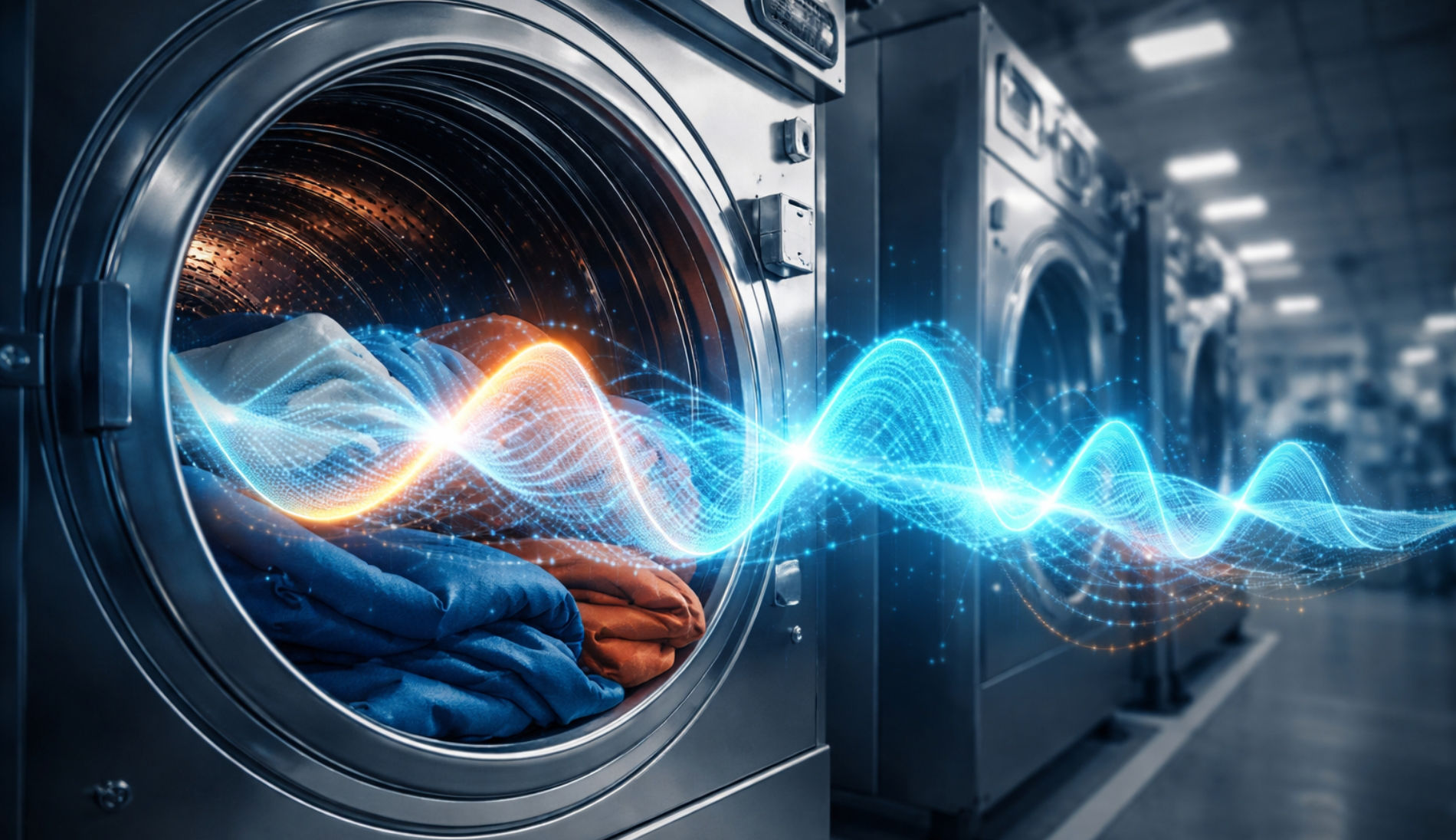
The research project carried out by the wfk and completed in 2024 used acoustic signals from a laundry load as a measurement variable for optimising moisture-controlled textile drying processes. The researchers recorded the rolling and falling noises of the laundry using structure-borne sound microphones integrated into a tumbler. In addition, structure-borne sound microphones mounted on the outer housing and an airborne sound microphone captured interference and ambient noises generated by the dryer. These extraneous noises were extracted from the useful audio signal by a computer and then analysed using a k-nearest neighbour (k-NN) algorithm. Based on the rolling and falling noises produced by a load depending on key drying process parameters and its textile-specific properties, the scientists developed their own complex algorithm for audio-based analysis of textile residual moisture. The wfk’s final report states that the model offers good predictability of residual moisture. When adapting the experimental setup to practical conditions, the method and the control of selected drying parameters also proved to be feasible. One crucial prerequisite must, however, be met: powerful computers are required for communication and data evaluation.
Drying process control using textile residual moisture monitors
Under project number IGF 19133 BG, the wfk and the Saxon Textile Research Institute (STFI, Greiz) developed a reprocessing-resistant residual moisture monitor for controlling the drying process in tumblers. To this end, the researchers integrated electrically conductive sensor fibres into a textile matrix and connected them to an RFID chip and a monitor antenna for energy and data transfer. The smart monitors measured textile residual moisture directly within the laundry load using an alternating current resistance measurement (impedance) and transmitted the data via a module with an external antenna and measuring computer. After determining the actual residual moisture in the tumbler, the researchers developed what the final project report describes as an appropriate process control system and adapted the process parameters that determine energy demand to the residual moisture in the laundry load. In addition, they developed recommendations for energy savings combined with textile protection for the individual drying phases.
Vector microwave reflection method for contactless online detection of textile residual moisture distribution
This wfk research project was completed in 2022. Its aim was to develop an automated method for the contactless online detection of moisture in single- and multi-layer textiles and for the three-dimensional visualisation of moisture distribution. The researchers selected a vector microwave reflection method and implemented the necessary microwave module with specially adapted antennas as well as calibration, measurement and evaluation algorithms. The method proved feasible in laboratory conditions. According to the IGF-funded project’s final report: “Using the developed microwave reflection method, local textile moisture distributions could be determined both on non-made-up fabrics and on made-up components. Localised areas of higher moisture were also tracked in moving parts in front of the antenna array’s field of view and could be spatially distinguished from one another.”
Thermomechanical textile drying using radial shock waves
In 2018, the wfk published its final report on a novel drying process using radial shock waves. The aim of the project was to accelerate the drying process while simultaneously reducing thermal stress, enabling more textile-friendly operation. To achieve this, the researchers combined conventional convective drying in drum dryers with the additional introduction of radial shock waves. These were intended to accelerate moisture transport from the textile interior to the surface, thereby counteracting excessive surface heating and the associated thermal fibre damage. The laboratory system developed within the research project for shock wave treatment was tested in two drying stages on defined materials, and the time course of drying was recorded. Based on the results, further investigations were carried out in two model dryers to minimise treatment time and textile damage while maximising machine utilisation. It was shown that the hot air temperature in the convective dryer can be reduced through the additional introduction of radial shock waves – with unchanged dehumidification performance and without significant textile damage.
The number of research projects focusing on the control and automation of industrial drying processes is limited. Even fewer studies are available in the field of industrial tunnel finishing. Instead, the international research community predominantly concentrates on drying processes in domestic appliances, the results of which can only be transferred to a limited extent to the specific requirements and framework conditions of industrial laundries. The commercial textile care sector will therefore continue to rely on the additional expertise of well-trained laundry professionals in the “drying department”.