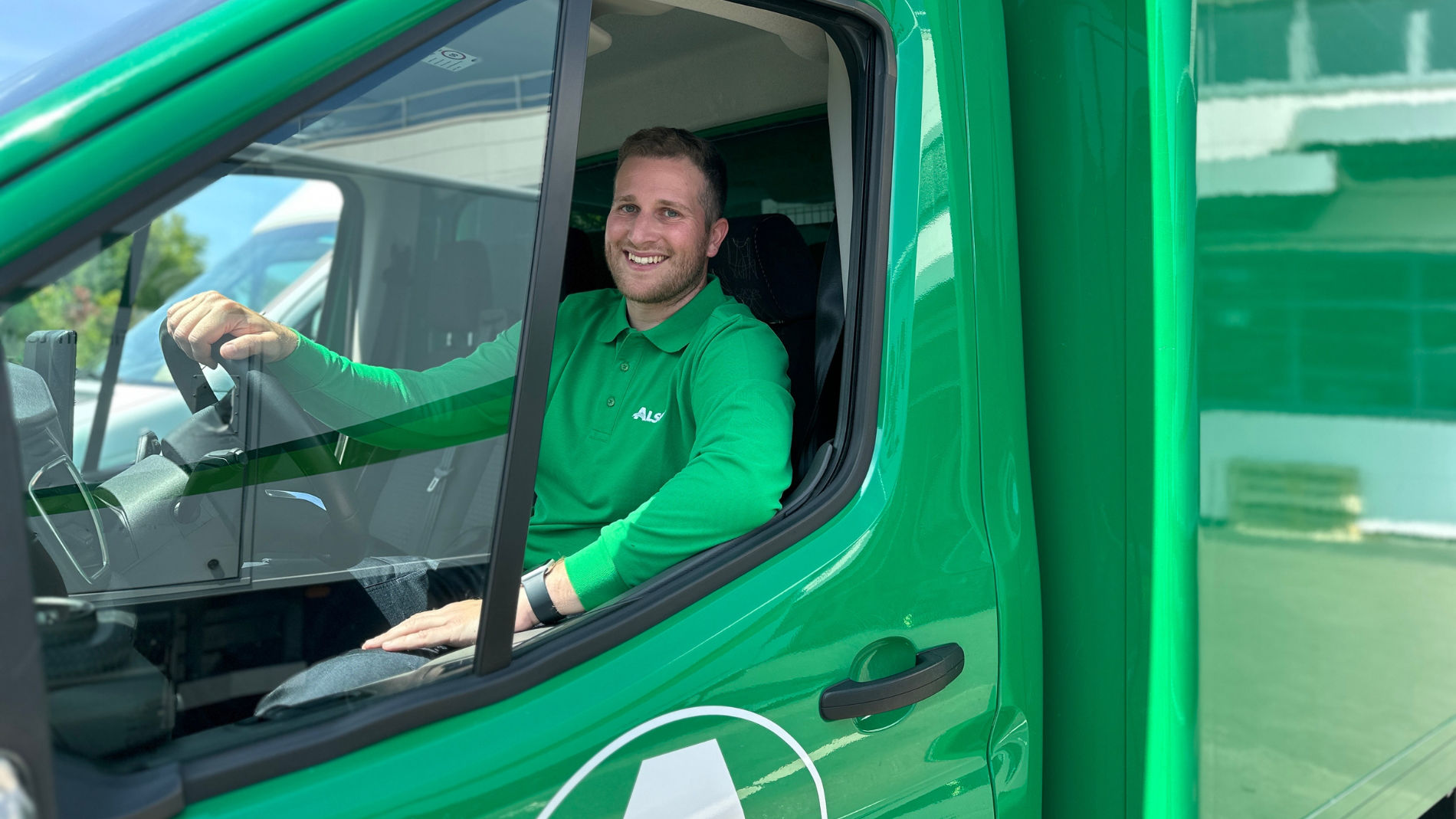
Service drivers are indispensable for textile-service providers
1 Jun 2026
Service drivers are the customer’s most personal link to their textile-service provider. Although the work is hard, many drivers continue working in the industry after completing their training, as a variety of technical innovations make the job easier.
The primary aim of textile-service providers is to supply customers with clean laundry. Behind this succinct summary, however, lies a vast amount of logistical expertise. This encompasses the collection of soiled laundry, the precise management of textiles through operational processes, customer-specific sorting, and the scheduled delivery and distribution of clean laundry to the customer. However, although the textile-services industry is highly technology-driven, its service-oriented nature necessarily incorporates a deeply human element, which enters the picture in the form of service drivers: they act as the link between the laundry and its customers, whose premises they visit regularly. As direct points of contact, they transmit feedback, reports and messages to the company, where the customer service team then deals with the various matters arising. Cutting off this channel of communication would soon lead to a breakdown in communication between the customer and the service provider. Hence, any textile-service provider hoping to gain an economic advantage by outsourcing its fleet of vehicles must be prepared for this consequence, with any advantages from outsourcing quickly being eroded by growing customer dissatisfaction and an increase in cancelled contracts.
“Service drivers are indispensable for textile-service providers”
Says René Schneider. The CEO of ALSCO Berufskleidungs-Service in Cologne, he spent many years working in sales and as a service driver, as well as in the company's fleet and service management. In this interview, he offers insights into working at the interface between indoors (the company) and outdoors (the customer).
Why do you say this, Mr Schneider?
René Schneider: When it comes to communication, customers have high expectations of us as a textile-service provider. They want to get any issues they have sorted out as quickly and smoothly as possible – and the service driver is often the first point of contact. Customer-satisfaction surveys consistently confirm the importance of this role with respondents regularly singling out service drivers for praise.
What distinguishes a good service driver?
René Schneider: Anyone visiting a customer should be personable, communicative and able to identify key information, which they should then pass on to the relevant office staff or customer-service team at the end of the visit. This ensures that the customer’s concerns are dealt with as quickly as possible and any issues are resolved straight away.
What qualifications do people need to have if they want to work as a service driver for a textile-service company in general and ALSCO in particular?
René Schneider: Ideally, applicants should hold a driving licence that authorises them to drive lorries with a gross vehicle weight of over 3.5 tonnes. It is even better if applicants have completed a service-driver training programme, a two-year dual-training programme recognised by the German Chamber of Industry and Commerce. We also require a good command of German and a certain level of physical fitness, as some delivery points are in buildings without a lift or within a sprawling complex. And, although our service drivers work a four-day week, we expect a certain degree of flexibility. As a service provider, we must ensure the supply of laundry to certain customers even over consecutive public holidays, which requires our drivers to go the extra mile. After all, a hotel cannot do without fresh linen throughout the Christmas period!
Have you been able to find sufficient applicants? After all, we keep hearing that delivery services are draining the market for drivers.
René Schneider: The shortage of applicants isn’t hitting us quite as hard as it is other parts of the logistics sector. In contrast to delivery services, textile-service companies have regular customers with designated drop-off points for laundry. Hence, drivers can hand over their goods straight away – without the stress of searching in vain for the recipient, without ringing doorbells, without waiting times and without extra paperwork. In fact, it is often the case that drivers from delivery services apply to us because they no longer want to work under constant time pressure.
What do you do if applicants only meet some of your requirements?
René Schneider: We know we have to make compromises. And this is why we decided years ago to offer service-driver training and, where necessary, pay for our apprentices to obtain the required driving licence. Additionally, we encourage them to take a language course if their German isn't very good.
What do service drivers learn during their training with a textile-service company?
René Schneider: Firstly, it is important to define the term ‘service driver’. In distinction to other drivers, they provide specific services to customers on behalf of the company. To do this, trainees must first familiarise themselves with our industry’s ‘products’ and understand any special considerations that need to be considered. At the same time, they gain an insight into route planning and organisation, learn how to drive and load the delivery vehicle, as well as secure the load and carry out a pre-departure check. They are responsible for delivering the laundry to customers and must ensure that the goods are delivered to the correct location. There, they collect any soiled laundry, load it correctly and bring it back to the depot, where they unload it and prepare their route for the next day. If the lorries are transporting hygiene-sensitive laundry, the service drivers’ duties also include disinfection. Additionally, service drivers are responsible for cleaning their lorries regularly.
Wet towels, mats and protective clothing are heavy. What aids are there to make the day-to-day work of service drivers easier?
René Schneider: In distinction to the past, there is now a wide range of technical and organisational equipment at the disposal of service drivers. Laundry – as well as mats – is sorted into roll-away mesh trolleys, hanging garments are ironed on rolling racks, and there are stair-climbing aids in the lorry, which means less physical effort is required to transport items from the vehicle to the drop-off point and back.
The daily route is no longer simply listed on a computer printout. Instead, the fleet team plans the routes, including the statutory break times, optimises the navigation using real-time traffic updates, and then saves the information on a handheld computer. This means that staff no longer have to memorise the tour and alternative routes, and they arrive at their destination on time.
What’s more, the working environment for service drivers is now very comfortable: our delivery vehicles are fitted with well-cushioned seats, automatic gearboxes and air conditioning. However, all these amenities cannot hide the fact that it's a tough job. Despite this, very few of our drivers want to do something else. They love their work and many stay with us until they reach retirement age.
Given all the support and aids supplied, everything should run like clockwork on the tours. Are there still situations where even the best planning doesn’t help?
René Schneider: Most times, everything really does run like clockwork. However, last winter was a reminder that the weather can throw a spanner in the works, no matter how well we plan. In some cases, delivery points hadn’t been cleared, and our drivers had to struggle through snow and ice with their roll-away containers. This caused major delays and turned the entire delivery logistics operation upside down. Sometimes the drivers even had to cut their rounds short and stay overnight in a hotel to ensure they did not exceed their statutory working hours.
Your service drivers visit a variety of customers every day. Does everything always run smoothly?
René Schneider: Naturally, our service drivers are only human. One of them once collected a laundry bag from a customer, left it on the ground behind his lorry, and then simply drove off. The following week, he wondered why there wasn't the usual amount of clean laundry for that particular company. And he couldn't explain why. The customer, however, was able to provide the answer. They had assumed that the service driver would come back to collect the items he’d left behind. So they’d left the laundry bag on the road. Shortly afterwards, however, the waste collection truck came around the corner ...
Stories like these can be amusing. However, there are also more unpleasant instances, such as verbal abuse or false allegations made by customers against a delivery driver. In such cases, we intervene immediately and take steps to resolve the issue.
And then, of course, some customers have dogs on the premises. Which means we can’t send a delivery driver who tends to panic around dogs and is too scared to even get out of the lorry. So, to ensure the customer gets their delivery, we have to reassign that driver to a different run. Fortunately, this is a rare occurrence.
Sabine Anton-Katzenbach
Graduate textile engineer and freelance journalist
Sabine Anton-Katzenbach holds a degree in textile engineering and works as a freelance journalist. For over three decades, she has been covering the textile care industry and reporting on its many different facets.