
Reading time: 22 minutes
From a YouTube video and a family-run laundry to a career change after 15 years in a foundry: the routes into textile care are as varied as the people who take them. In this collection of voices, 47 aspiring textile care specialists, aged 18 to 54, from 34 laundries and four vocational schools explain how they entered the profession, what has surprised them about their day-to-day work, what motivates them – and what businesses can do to attract new talent. Their answers, in their own words, paint a multifaceted picture of a future-proof industry that has far more to offer than meets the eye.
Apprentices’ voices – organised by topic
Expand the topics and explore the individual responses.
How did they find their way into textile care? (8 voices)
The routes into the textile care industry are diverse: through family connections, chance, temporary jobs, career changes – and sometimes a YouTube video.
“I saw a video on YouTube”
“I saw a video on YouTube showing bed linen being fed into an ironer – and I really liked it. Today, I am interested in all the machines in the laundry. What surprised me most was that you do not just learn how textiles should be treated, but also about fibres, technology, detergent ingredients, the environment and sustainability. When I told my parents that I wanted to become a textile care specialist, they said: ‘Follow your dream.’ My best moment in training so far was passing my final examination and no longer being an apprentice. :) To become more attractive to young people, businesses could let their apprentices rotate between departments: production, service, finishing and washing – that would make for better training. And: higher pay.”
Hien Dien Nguyen, 28 · third year of training · Kyffhäuser Textilservice · Anni Albers School for Fashion, Media and Design, Frankfurt am Main
“Before training as a textile care specialist, I worked in a foundry for 15 years”
“I worked in metal production at a foundry for 15 years before starting my training as a textile care specialist. I was fascinated by how textiles can be washed and cleaned properly. What impressed me most was stain removal. The best part so far has been developing my skills and discovering the potential within myself. Textile care is diverse and offers many opportunities for progression and further training. You learn a great deal that hardly anyone can do perfectly in everyday life – when it comes to textile care, no one can pull the wool over your eyes anymore.”
Micael Almeida Figueiredo, 35 · second year of training · Merkle Reinigung · Anni Albers School for Fashion, Media and Design, Frankfurt am Main
“I ended up in textile care by chance”
“I ended up in textile care by chance. I was immediately impressed by the machinery and technology. I also have a great group of colleagues and good teamwork. When I told my parents about it, they said: ‘Complete nonsense.’ But textile care is worthwhile if you work your way up, become a master craftsperson, pursue a dual study programme or aim for more senior positions.”
Anonymous
“I worked in textile care before starting my training”
“I worked in textile care before starting my training and realised that I enjoyed the work. It can be stressful at times when the laundry has to be ready to go out again that very day, but there are fun days too. Starting the training was a good decision.”
Maxi Sophie Barschke, 19 · first year of training · Elis Stralsund · Regional Vocational Education Centre Greifswald
“I wanted a better job”
“I started the training because I wanted a better job. I was then surprised by how many opportunities the training offers. It is not that easy, but it is not that difficult either. The best thing so far has been making new friends through the training. Businesses should advertise more and explain clearly to young people what textile cleaning is all about.”
Ben Hassine Mouadh, 27 · second year of training · MEWA Textil-Service AG & Co. Groß Kienitz · Anni Albers School for Fashion, Media and Design, Frankfurt am Main
“I didn’t know this training existed – then I found it really interesting”
“I did not know that this type of training as a textile care specialist existed, but when I found out about it, I thought it was very interesting. Textile cleaning is something people often do at home, but not in the right way. I find it exciting to learn how to use the information on garment care labels to look after textiles correctly. It is also interesting to learn more about how each individual machine treats every item of laundry with particular care. I believe that training in textile care could appeal to many young people because of its broad range of learning opportunities.”
Valeria Restrepo Delgado, 29 · second year of training · Wäscherei Schwarting · Theodor Litt School, Neumünster
“The pay and career prospects motivated me”
“What motivated me most was the pay – and the fact that there are many opportunities for progression. My coolest moment was when our production manager showed me how the ironer works and a crowd gathered around us to watch. Businesses should promote the profession more, because many people I know are not even aware that this apprenticeship exists.”
David Holder, 20 · first year of training · Wilhelm Wulff · Anna Siemsen School, Hanover
“I worked as a temporary assistant at the laundry beforehand”
“I worked as a temporary assistant at the laundry over the summer. My mum is pleased that I am doing the training because she worked there herself. My friends did not even know what the term ‘textile care specialist’ meant. What I enjoy most is stain removal – getting rid of marks from things such as ballpoint pens or sauces. My coolest moments so far have been visiting Oktoberfest with the company and the Christmas party, with a Christmas meal and music. I would tell young people: there are lots of interesting things to learn here, such as how all the workwear arrives with us, is washed, finished, folded, packaged and delivered back out. There are also many nice people to work with.”
Anastasiadou Christina, 18 · second year of training · DBL Staufer Textilpflege · Anni Albers School for Fashion, Media and Design, Frankfurt am Main
What surprised them about textile care? (9 voices)
“I never would have thought…” – what has surprised the apprentices.
“I was enthusiastic from the very beginning”
“Businesses looking for young people should tell them that it is a secure job with real specialist expertise. From the start, I was impressed by the unexpectedly high technical complexity of the machinery and processes, the combination of craftsmanship and technical know-how, and the quickly visible results. Businesses should use social media to show how modern the technology is. They could also place greater emphasis on salary progression. My coolest moment so far was when I managed to solve a complicated mathematical problem. My parents thought it was great because it is a solid skilled trade with strong demand for qualified workers.”
Manh Dung Nguyen, 24 · first year of training · Cleanmaster Textilpflege plus · Anna Siemsen School, Hanover
“I had never seen anything like it”
“I started the training because I saw online that textile care is a profession with a future. At the company, I was surprised by the large machines – I had never seen anything like them before. I would recommend that businesses advertise more, increase apprentice pay and give apprentices detailed work instructions.”
Xuan Viet Dung Nguyen, 27 · third year of training · Waschbär · Anna Siemsen School, Hanover
“Show just how technological and innovative textile care is”
“In the country we come from, my mother owned a clothing company. When I told my brothers that I was training as a textile care specialist, they were surprised. At the company, I was surprised by the area where the soiled laundry arrives. I think businesses should do more to show how technological and innovative textile care is in order to inspire more young people to join the profession.”
Paz Palacios Carlos, 28 · first year of training · Seidel · Anna Siemsen School, Hanover
“What lies behind textile care is enormous”
“Many people think textile care is simply washing laundry, but what really lies behind it is enormous. We have our own family-run laundry, and naturally my parents were pleased that someone would carry it on. I enjoy the fun conversations with customers and partners. I think people could earn a little more, and apprentices should occasionally be offered something too – vouchers, outings or similar. There are plenty of options; come up with something. ;)”
Levin Schulz, 21 · third year of training · Exakt-Reinigung · Anni Albers School for Fashion, Media and Design, Frankfurt am Main
“My parents said: ‘What is that?’”
“When I told my parents that I was training as a textile care specialist, their first reaction was: ‘What is that?’ I said it is like a laundry – but with large machines. At first, I was surprised by how much we learn in class about fibres, detergent ingredients and cleaning technology. I am impressed by the way our teachers teach us. Textile care is a good choice for anyone who wants to learn new things. I have made new friends here and can practise German at school. To young people considering training in textile care, I would say: you have to give it a try!”
Rifky Putra Wijaya, 22 · second year of training · Wäscherei Diener · Anni Albers School for Fashion, Media and Design, Frankfurt am Main
“I had never seen machines like these before”
“From the start, I wanted to train as a textile care specialist. I find most of the machines developed for this work very impressive – I had never seen anything like them before. I hope businesses will teach young people even more about textile care.”
Rawand Hussein, 20 · second year of training · Sitex · Anna Siemsen School, Hanover
“I am impressed by how much laundry goes through a laundry every day”
“What impresses me most is the volume of laundry that passes through a laundry every day. I had already worked in a laundry before, and I see training as a textile care specialist as an opportunity to develop professionally and increase my earnings. What I enjoy most are the days at vocational school. I would say to young people: day-to-day work is varied, and once you have completed the training, a wide range of further training opportunities is available.”
Denise Lenzen, 31 · second year of training · Wäscherei am Uniklinikum Aachen · Anni Albers School for Fashion, Media and Design, Frankfurt am Main
“Perspectives in textile care have changed considerably in recent years”
“Perspectives in textile care have changed considerably in recent years. Today, training in textile care can genuinely be very beneficial – both for one’s personal and professional future. What surprised me most was the amount of technical knowledge and understanding required. When I told my parents about my training as a textile care specialist, they said: ‘Now we know where to take our laundry.’ Businesses should keep highlighting the career prospects, how much textile care has evolved, and that it is not just about textiles, but also about technology and chemistry.”
Katharina Matthiesen, 30 · final year of training (accelerated programme) · CWS Healthcare · Theodor Litt School, Neumünster
“Textile finishing impressed me most”
“I have always been interested in different types of fabric – their structure, colour and composition. But I had never seen textile care as a profession from the inside. At the company, I was most impressed by textile finishing and the various ironing and folding machines. It was also interesting to learn which detergents to use correctly when cleaning textiles. I would advise young people to find out more about textile care – it is a profession that can be useful in everyday life, at home and virtually everywhere.”
Alsinia Khabibullina, 54 · first year of training · Wäscherei Diakonie Nord Nord Ost Lübeck · Theodor Litt School, Neumünster
Why do they recommend textile care? (10 voices)
Security, variety and promising prospects – why apprentices see a future in the textile care industry.
“You won’t regret it!”
“Through the training, I want to learn about the processes, methods and different areas of work, and make new friends. I worked in a laundry for a year and a half and was genuinely impressed by how well organised it was. Because I enjoyed it so much, I am now training as a textile care specialist. I think young people should not hesitate for too long – it is the best decision they can make. The training is truly something special and offers good prospects on the job market. You won’t regret it! Businesses, meanwhile, should support people’s desire to learn, no matter how old they are. That is how they can create a country full of opportunities.”
Anonymous
“You are never too old for training!”
“I had already worked in textile care for ten years. When my company was looking for people to train as textile care specialists, I took the opportunity. I had not expected that you also need to be good at chemistry and maths – that really surprised me. It is definitely a profession that will not die out, because there will always be dirty laundry. What I have enjoyed most so far are the seminars and visits to major companies such as Kannegiesser. My two children think it is great that I am doing training again at my age. I believe: you are never too old for training!”
Denise Stoevesandt, 39 · third year of training · Jahnke Textilpflege · Anna Siemsen School, Hanover
“You do something meaningful every day”
“I wanted a profession where I could work with my hands and see the result straight away. I was surprised by how varied the work in textile care is. It is certainly a demanding profession, but it has a future and you do something meaningful every day. My coolest moment so far was operating a large machine and having everything go really well. My parents and friends were initially surprised when I told them that I was training as a textile care specialist, but they were also proud that I was doing something practical and important. Businesses should do far more to show how modern and varied the profession is.”
Anonymous
“A secure profession with a future”
“I chose training in textile care because clean, well-kept clothing matters to me and I enjoy practical work. I was surprised by how friendly and helpful all my colleagues are. I also did not expect to learn so many new things in such a short time. I would tell young people that textile care is a secure profession with a future. You learn a great deal about different fabrics and always have varied tasks. My coolest moment was realising how much I had already learned and being able to work independently. My parents and friends reacted positively. Businesses should show how varied and important work in textile care is, and give young people more insight into it.”
Robin Aksoglu, 30 · Anna Siemsen School, Hanover
“The job keeps you mentally as well as physically fit”
“I had already worked in a laundry for six years before training as a textile care specialist. Now I want to improve my knowledge and continue my training so that I can do a better job – but also because I enjoy the work. What surprised me most was the complexity of the profession: how much you need to pay attention to, and how many different fields of application and machines there are. It is a varied profession that keeps you mentally as well as physically fit. There are many opportunities for further training, which can be useful not only in laundries and dry-cleaning businesses but in private life too. My friends did not know that this profession existed or that it was so unusual. Businesses should offer young people every kind of support – not only in the practical aspects, but also in the theoretical side. They should also point out opportunities for further training and make the profession varied.”
Elif Durmus, 25 · third year of training · Zentralwäscherei an der Uniklinik Freiburg · Anni Albers School for Fashion, Media and Design, Frankfurt am Main
“Textile care is more varied than you might think”
“I was surprised by how much specialist knowledge is involved in textile care. The combination of practical work, responsibility and customer focus continues to motivate me in my textile care training. My coolest moment so far was completing a difficult specialist assignment entirely independently for the first time. To young people still looking for an apprenticeship, I can only say: textile care is more varied than you might initially think.”
Abhilghb Babu · second year of training · Göddecke Textilpflege · Anni Albers School for Fashion, Media and Design, Frankfurt am Main
“A solid profession with good prospects”
“I chose training in textile care because I like working carefully and enjoy practical tasks. I was surprised by how much specialist knowledge and attention to detail textile care involves. What interested me most was stain removal, as I treated different kinds of stains. I would tell young people that becoming a textile care specialist is a solid profession with good prospects and is worthwhile because you learn many practical skills.”
Thi Minh Chau Nguyen, 25 · second year of training · Kyffhäuser Textilservice · Anni Albers School for Fashion, Media and Design, Frankfurt am Main
“A secure future in Germany”
“I decided to train as a textile care specialist because I want a permanent job and a secure future in Germany. What I like most are the many modern machines, ironers and dryers, as well as working with solvents such as perchloroethylene (PER). My parents were surprised, but also pleased that I had found secure training.”
Tran Quoc Trong, 31 · Waschbär · Anna Siemsen School, Hanover
“You feel like a professional”
“I looked for a training position as a textile care specialist because I had previously worked unskilled in a laundry and earned very little there. I was surprised by how much laundry we wash – that was something new for me. I definitely enjoy it: you are always accomplishing something and learning something new every day. You feel like a professional – and after the training, you are one. My best moments are at vocational school – I have a great class and very kind teachers. I really enjoy school.”
Emal Makkzadu, 24 · second year of training · MEWA Textil-Service, Rodgau site · Anni Albers School for Fashion, Media and Design, Frankfurt am Main
“It is a profession that will never die out”
“I have always enjoyed doing laundry at home. I am training as a textile care specialist because it is a profession that will never die out – laundry will always need to be washed.”
Anonymous
What were their best moments? (7 voices)
Their first major laundry job, team experiences or a visit to Texcare – these are the moments apprentices remember most.
“My first large wash load was a special moment”
“I like clean, tidy work and enjoy working practically with textiles. It is a secure job. A special moment was when I handled my first large wash load on my own.”
Saeed Nematollahi, 21 · first year of training · Gemeinschaftswäscherei Himmelsthür GmbH · Anna Siemsen School, Hanover
“My best moment? Finding out I was the first apprentice at my company”
“I am changing careers and quickly realised that I enjoy the job far more than I expected. I am doing the training because I want to understand why and how I do things. My best moment so far? Finding out that I am the very first apprentice at my company. I was surprised by how little known the profession is. There are so many opportunities after the training. I would recommend that businesses let their apprentices work in all areas.”
Tim Danielmeyer, 38 · third year of training · Diakonische Stiftung Wittekindshof · Anna Siemsen School, Hanover
“The best moment is arriving at work to a smile”
“The best moment is arriving at work and being greeted with a smile and a ‘good morning’. I have a great team to laugh and have fun with. What surprised me personally was that there is so much more to textile care than you might think. My parents and friends were not that enthusiastic, but I find the profession very varied and interesting. It was difficult to find this profession because it is so little known – other people drew my attention to it.”
Tino Bata, 18 · third year of training · Kyffhäuser Textilservice · Anni Albers School for Fashion, Media and Design, Frankfurt am Main
“My coolest moment so far was when I received my pay.”
“There are many modern washing machines that I had never seen before. My coolest moment so far was when I received my pay. That was also one of the reasons I chose textile care: I want to earn money.”
Van Trung Do, 23 · second year of training · Wäscherei Grete Rommel · Anni Albers School for Fashion, Media and Design, Frankfurt am Main
“I am always pleased when I get out and can travel to vocational school”
“I wanted to find work as quickly as possible. Today, I like the profession. I am always pleased when I get out of my city and can travel to Frankfurt for vocational school. My coolest moment so far was passing my intermediate examination.”
Oumar Bah, 26 · third year of training · Kingsgard V.I.P. Chem. Reinigung München · Anni Albers School for Fashion, Media and Design, Frankfurt am Main
“My coolest moment was visiting Texcare”
“I joined my laundry as a newcomer through a close acquaintance. Over time, my interest in learning the profession in more detail grew. When my boss offered me the opportunity to train as a textile care specialist, I agreed immediately. In my day-to-day work, I enjoy treating stubborn stains. My friends think it is great that I am learning such an unusual profession. My coolest moment so far was visiting Texcare in Frankfurt am Main.”
Yasemin Türkal, 41 · second year of training · Jahnke Textilpflege · Anna Siemsen School, Hanover
“Solving the puzzle is a great feeling!”
“A friend introduced me to textile care. I quickly realised that the industry has a secure future – fashions and trends change, but people will always need clothing and everyday textiles. At the laundry, I was surprised by how much attention we have to pay to small details and how much science lies behind it. It is fascinating how physics, chemistry, biology and maths all interact here, and it is far more varied than you might think. For example, I learned how important the right spin speed is for the washing machine: if it is too high, the textiles ‘stick’ to the drum due to centrifugal force. But you do not just learn how to operate large machines; you also understand the entire washing process from start to finish. You often have to think logically to find solutions.
What I enjoy most is spot treatment (Editor’s note: the targeted pre- or post-treatment of stains before washing or cleaning agents are applied). It is like doing a puzzle or solving a riddle: we analyse the stain and have to work out which product is right for it. Stains that look extremely difficult are often very easy to remove. Conversely, small, inconspicuous stains can be a real challenge. But solving the puzzle is a great feeling! My parents and friends think it is a good career choice – they now understand that textile care is an industry that cannot be replaced, because clean textiles will always be needed. Anyone looking for an apprenticeship should definitely give textile care a chance. Why? Because it never gets boring. My tip for businesses: have fun, no stress!”
Michellen, 25 · second year of training · Wäscherei Diener · Anni Albers School for Fashion, Media and Design, Frankfurt am Main
What are their tips for businesses on attracting new talent? (13 voices)
Practical ideas for attracting new talent – directly from the target group.
“Businesses should take young people seriously”
“I was motivated to train in textile care by my interest in practical, clean and structured work. What surprised me most was how varied the tasks are and that teamwork is much more important than I had thought. My best moments so far have been my first independent machine run and when customers and colleagues are satisfied with my work. Businesses should take young people seriously and let them get involved in the work. They should also give them more insight into professional textile care, for example at trade fairs or in schools.”
Charlotte Schütt, 18 · first year of training · Textilservice Bernd Grommelt · Regional Vocational Education Centre Greifswald
“Work placements, trial shifts and good support at the beginning help a lot”
“I am doing the training because I want to study, work and earn money in Germany. I was surprised by how modern many of the machines are and how well everything is organised. My best moment so far was when I was able to operate an entire machine independently for the first time – I was proud that I had managed it. Textile care is a secure and stable profession. You learn a great deal about quality, hygiene and organisation. There are good career prospects and you can quickly take on responsibility. I think businesses should show young people how varied and important the profession is. Work placements, trial shifts and good support at the beginning help a lot. When apprentices feel welcome and supported, it is very motivating.”
Thi Khanh Hoa Dinh, 21 · second year of training · Wäscherei Grete Rommel · Anni Albers School for Fashion, Media and Design, Frankfurt am Main
“Present the profession in schools and show the career opportunities”
“My sister motivated me to start the training. She had trained as a textile care specialist herself and always talked about it, so I knew what to expect. My parents and friends supported me from the beginning. I enjoy the days when I laugh a lot with my colleagues and we all get on well. I would say to businesses: present the profession in schools and show the career opportunities it offers.”
Selmedina Tahiri, 19 · first year of training · Seidel · Anna Siemsen School, Hanover
“Let young people bring in fresh ideas!”
“Three and a half years ago, I applied to my current company out of necessity. The apprenticeship was not planned, but I am doing it now because I fell into it. From an educational perspective, I really enjoy the training. My funniest moment so far was when I accidentally tore a hole in a tablecloth in goods receiving, my manager tried to ‘save’ it and made a second, much bigger hole. To businesses looking for new talent, I would say: let young people bring in fresh ideas so they can challenge old ways of doing things! Something does not have to be good just because ‘it has always been done that way’.”
Sabrina Fritz, 35 · first year of training · Textilpflege Picobello · Anna Siemsen School, Hanover
“Show the variety – and create a good working environment”
“I wanted to work practically, take responsibility and learn a profession involving technology and quality awareness. Textile care is a stable, future-proof profession in which you quickly work independently and have many prospects. I was impressed by how much specialist knowledge, planning and teamwork lie behind textile care. My coolest moment so far was being allowed to supervise a production line independently – the trust placed in me and my influence on quality were highly motivating. My parents were surprised at first, but once they understood how important textile care is, they were proud and supported me. To businesses looking for apprentices, I would say: show the variety and practical side of the work, give insights into development opportunities and create a good working environment – that motivates young people.”
Jeremie Charles Amuli, 26 · second year of training · Geschwister-Gummi-Stiftung · Anni Albers School for Fashion, Media and Design, Frankfurt am Main
“Give new people a friendly welcome and train them in well”
“Textile care suits me because I like working neatly. I wanted to learn a practical and secure profession. I was surprised by how many machines there are and how professionally everything is organised. The profession is not that difficult – you learn quickly and have good career prospects. My best moment was operating a machine properly on my own for the first time. Businesses should give new people a friendly welcome and train them in well – that makes it easier to get started.”
Thi Phuong Nguyen, 25 · second year of training · Wäscherei Grete Rommel · Anni Albers School for Fashion, Media and Design, Frankfurt am Main
“My three tips for laundries looking for young people”
“The opportunities for progression at the company motivated me to train as a textile care specialist. (P.S. The money too!) We have a great working atmosphere here, with lots of humour in the workplace. My best moment so far was team training with my vocational-school class. My three tips for laundries looking for young people: openness, understanding and support.”
Alina Wagner, 19 · second year of training · MEWA Textil-Service AG & Co. Groß Kienitz oHG · Anni Albers School for Fashion, Media and Design, Frankfurt am Main
“Businesses should have a stronger presence at careers fairs”
“I generally really enjoy going to work. I like all my colleagues – there is always someone here to laugh or talk with. When I started training as a textile care specialist, I was not surprised by the size and complexity of a laundry because my father has worked in textile care for a long time and I already knew many of the career prospects. But I now wanted to learn the fundamentals of professional textile cleaning myself. At first, I was surprised that the muscle soreness was much more intense and lasted much longer than I had expected. Businesses should promote themselves more and, for example, be more present at careers fairs attended by pupils – I think many of them are not really aware of the industry. Yet it is a large sector with many different areas. After completing the training, there are an enormous number of opportunities to work your way up. For example, I would like to work in sales in textile care later on.”
Emily Loeck, 20 · first year of training · Exner Wäscherei & Reinigung · Theodor Litt School, Neumünster
“Businesses could make videos on TikTok”
“I started training in textile care because I am interested in garment care. My parents and friends said they had never heard of the industry. But if you are interested in this kind of work, you can definitely choose to become a textile care specialist because you learn a lot about garment care here. I was surprised by how many different machines there are for caring for textiles. It was really great that we visited many companies and trade fairs and went on excursions with the vocational school. To reach young people more effectively, businesses could make videos on TikTok. To introduce textile care training to young people abroad, they could work with the Goethe-Institut.”
Do Thi Thuy Linh, 31 · second year of training · Waschbär · Anna Siemsen School, Hanover
“Textile care is a niche, but it is still essential”
“I think textile care is a niche in some ways, but it is still essential. I was particularly impressed by the logistics in a large-scale laundry. The industry is much more varied than people think. You can see training as a textile care specialist as a foundation and then continue your education in many different directions. To inspire more young people to pursue a career in textile care, businesses could demonstrate the variety of tasks – from working with modern machines to logistics – and respond more to apprentices’ wishes.”
Henry Exner, 19 · first year of training · Großwäscherei Paul Duncker · Theodor Litt School, Neumünster
“Businesses should pay apprentices more”
“Before starting my training, I completed a work placement at a laundry and really enjoyed it. In textile care, there are many opportunities for further training. The pay is low at first, but after a few years it becomes worthwhile. To inspire more young people to pursue a career in textile care, businesses could pay apprentices more.”
Anonymous
“That is meant to go in the machine, not in front of it”
“I chose to train as a textile care specialist because the profession is so varied and you learn many interesting things. I find it exciting how differently each garment has to be treated, how large-scale and automated some processes in the laundry are, and how many different washing programmes there are. Learning and working are more enjoyable than you might think. Sometimes I have to load large washer-extractors manually and, as I am not exactly the tallest, something occasionally falls out again – then my trainer always comes up with a funny comment, for example: ‘That is meant to go in the machine, not in front of it.’ That is pretty cool. Businesses that want to inspire young people to enter textile care could perhaps advertise more on social media.”
Lea Fischer, 21 · first year of training · MEWA Textil-Service Lauenburg · Theodor Litt School, Neumünster
“Businesses should post more on TikTok and Instagram”
“My mother motivated me to train as a textile care specialist. She works in textile care too. Businesses should post more videos on TikTok and Instagram.”
Anonymous
What the responses reveal
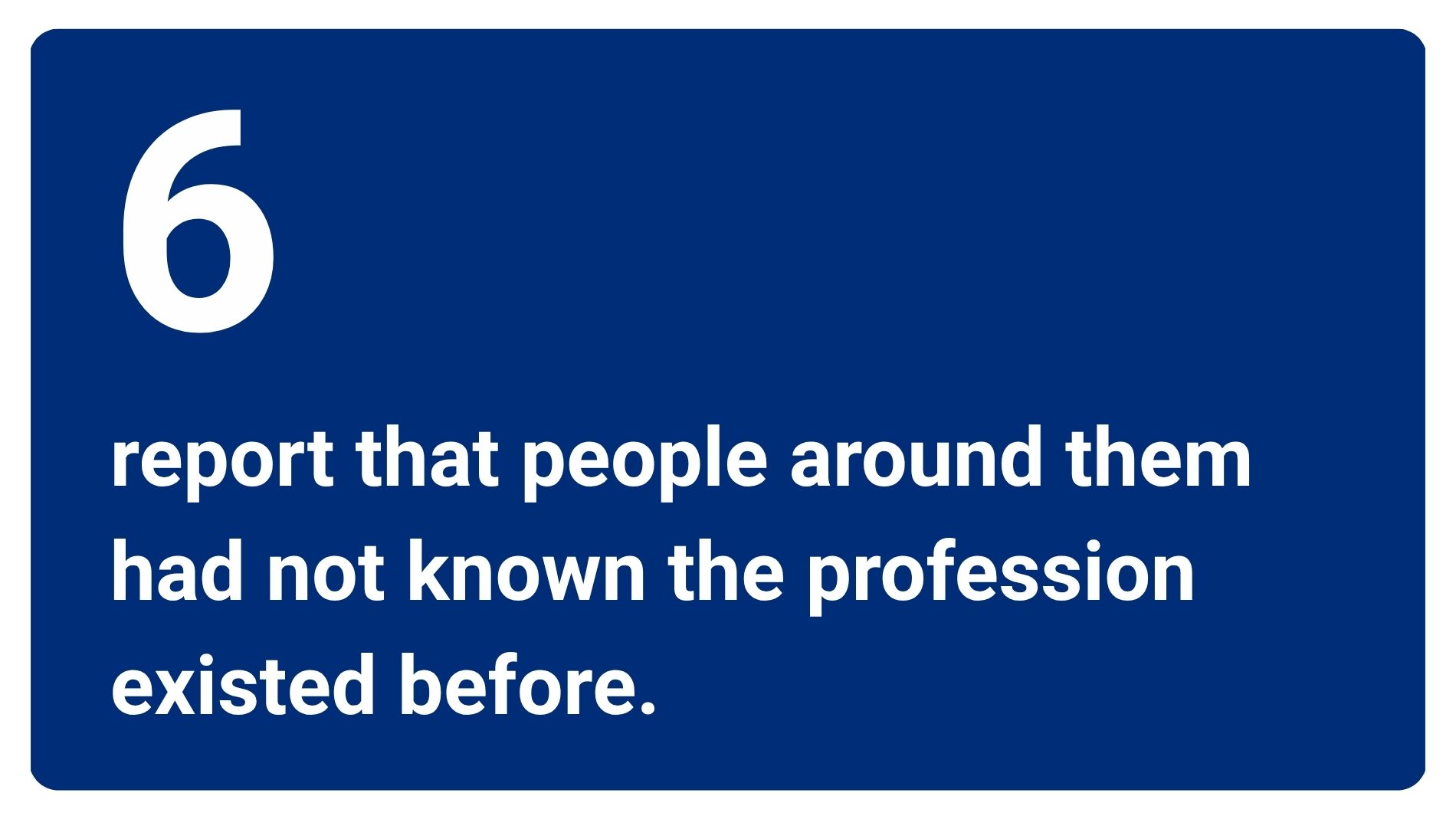
The responses show that many apprentices discover textile care more or less by chance – through family, work placements or a part-time job, for example. They are particularly impressed by the technical variety of the profession. Job security, variety and visible results are among the most common reasons why they would recommend the training to others.


What businesses should do, according to their apprentices
To attract new talent, respondents above all want greater visibility and a positive start at the company. They mention a presence in schools, work placements and trial shifts, social media, as well as reliable support and appreciation throughout day-to-day training.
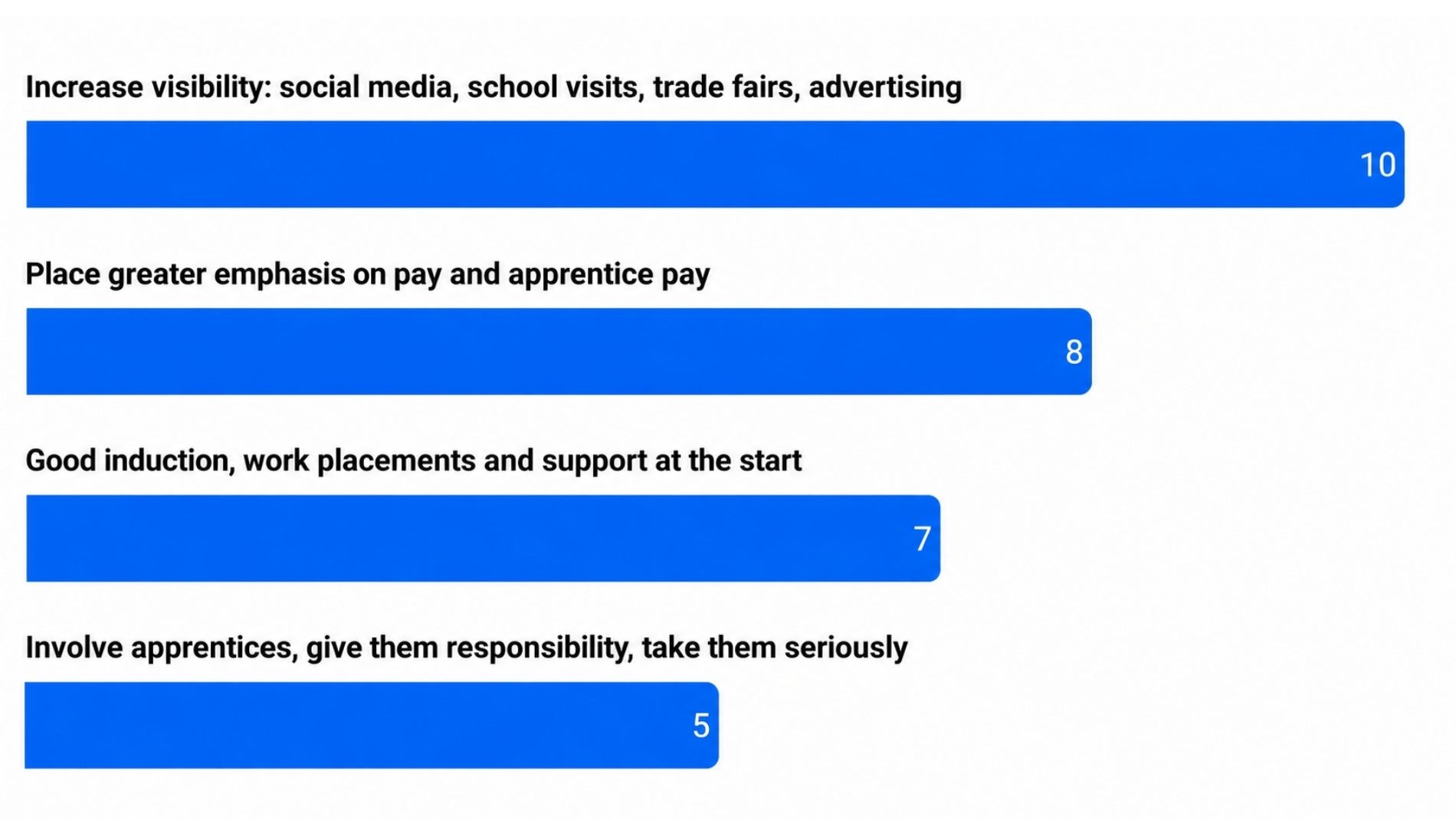
Number of responses with the relevant recommendation (n = 47)
About this collection of voices
All quotes were collected with the kind support of the Anna Siemsen School, the Anni Albers School for Fashion, Media and Design, Frankfurt am Main, the Theodor Litt School, Neumünster and the Regional Vocational Education Centre Greifswald. All apprentices answered a standardised set of questions. The published quotes were approved for publication by the apprentices themselves or with their consent via their respective vocational schools or training companies. Some quotes have been lightly edited or shortened for editorial purposes, without changing their tone or meaning. Not all responses received could be published, for example because the necessary approval had not yet been obtained at the time of publication. Some voices appear anonymously at the contributors’ request. The collection is continually being expanded.
Are you training in textile care yourself and would like to share your experiences too? Then email us at textilecare@messefrankfurt.com and become part of this collection of voices.