
Reading time: 10 minutes
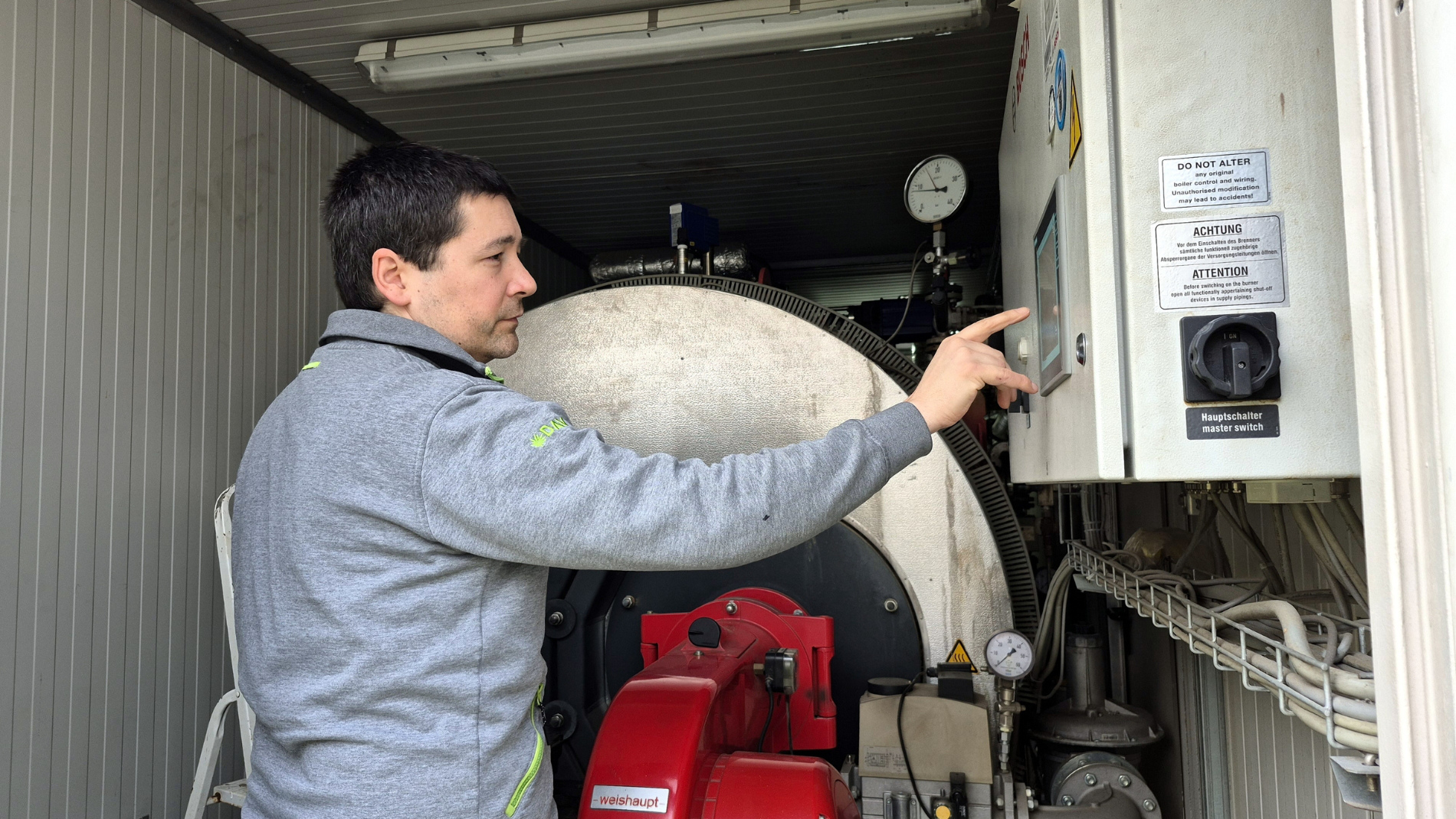
At five o’clock in the morning, Thomas Perski is the first to arrive at the premises. He starts by switching on the systems – air, water, boiler. “I power up the whole operation,” he says. Once the boiler has reached the right steam pressure after about 45 minutes, he starts the washing machines and loads the first dryers. At around 6:30 a.m., the team arrives and takes over the prepared machines. Perski then heads to the office, where the first emails are waiting: order confirmations, technical questions from customers, enquiries from suppliers, and messages from the staff. At 6:45, he walks through the facility and greets everyone personally: “It’s important to me that people share a quick smile in the morning.”
That Perski would one day become the head of his own laundry business with around 70 employees was something no one would have expected – least of all himself. “No one would ever have thought I’d go into a trade,” says Perski, who comes from an academic family. But things were to turn out differently.
“Am I in the right place?”
Perski’s life plan seemed clear: after finishing school and completing military service, he enrolled in law at the University of Marburg at the age of twenty. His goal: to become a public prosecutor. “A dream job for many lawyers, because it’s where the action is,” he says. In one of his first lectures, he sits among around 300 students and hears a classic line often used by lecturers: “Take a look to your left and right – you won’t be seeing these fellow students in a few semesters’ time.” In the front row, someone in a suit is typing away on a laptop. “That’s when I started asking myself: am I in the right place here?” Perski recalls. To finance his studies, he takes a part-time job at a small laundry in Marburg. What begins as a means to an end quickly develops a pull of its own.
“Suddenly, I was spending more time at work than in lectures”
At first, he handles delivery runs, taking clean laundry to customers twice a week in the evenings. But he quickly finds his feet, takes on additional responsibilities, and soon starts training new drivers himself. At some point, he realises that hands-on work suits him better than poring over files. “All of a sudden, I thought: I really enjoy working in a trade!” What he particularly likes is the variety: “It wasn’t just washing laundry – it involved chemistry, physics, engineering – and you more or less become a small-scale mechatronics technician on the side in textile care,” says Perski with a laugh. He also enjoys the physical aspect of the job. It’s a gradual process, but one day he realises: “I was suddenly spending more time at work than in lectures.” So he makes a radical decision.
Textile Cleaner Instead of Public Prosecutor
After six semesters, he drops out of his law degree and begins an apprenticeship as a textile cleaner. In his mid-twenties, he swaps the lecture hall for the textile care training centre at the Anni Albers School in Frankfurt (then still known as the Frankfurt School for Clothing and Fashion). “At first, there was this thought: you can’t do this. You’re on your way to a law degree and now you want to become a textile cleaner?” But the doubt doesn’t last long. “All of a sudden, I was completely certain: this is my path now.” And his parents? “They threw their hands up in horror,” he says with a laugh.
During his training, which begins in 2007, Perski continues working at the laundry. There, he learns more about the machines and the technology – and how to stay calm when things go wrong. “My old boss once said: Thomas, if a washing system breaks down, don’t panic. The problem is either mechanical, pneumatic, or electrical – there’s nothing else to those machines. If you can turn the shaft and it moves, it can only be air or electrics.” It’s a lesson Perski still follows today: stay calm, even in the biggest breakdown.
“In a laundry, you just say it as it is”
In 2010, he completes his apprenticeship. But that’s not enough for him, so he immediately goes on to train as a master craftsman. “With the decision to go into textile care, everything just clicked – this was exactly the life I wanted to lead.” What appeals to him about the field? “During my law studies, I often wondered how best to phrase things. In a laundry, you just say it as it is.” The sense of community is different, too. “From the very beginning, I experienced people in textile care as warm and straightforward,” says Perski. “At university, everyone was more or less on their own, but in a laundry everything is interconnected: if there’s a bottleneck in one place, everything gets pushed back.” It’s precisely this teamwork, this sense of togetherness, that he values. “Laundries are like melting pots – many different people, views, origins and backgrounds working together every day to achieve something, because everyone contributes their part. That’s what I like about textile care.”
Experienced Operations Manager Seeks Laundry Business to Buy
Even while completing his master craftsman training, Perski applies for a position as operations manager at a large-scale laundry. He gets the job and works there for 13 years with around 45 employees. He can imagine taking over the business. When he realises that won’t be possible, a long-held ambition grows stronger: owning a laundry of his own. He looks at various businesses, including an airport laundry, but nothing feels quite right. So in 2023, he places an advert in an industry magazine: “Experienced operations manager seeks laundry business to buy.” For a week, there is silence. “I thought: great, I’ve just wasted hundreds of euros.” What he doesn’t realise is that the publisher is collecting all the responses in the background. “All of a sudden, I received a package with almost 50 letters,” Perski recalls. The replies come from laundries and dry cleaners across Germany, many handwritten. “I couldn’t reply to all of them, but one thing was clear: anyone who wrote to me personally would get a personal reply.”
“Dear Mr Operations Manager…”
Among the responses is also a laundry owner from Swabia. Perski, himself a Swabian, negotiates with him for three quarters of a year – without success. When he talks about it, he laughs: “On a personal level, it would have worked, but when two Swabians negotiate over money, it’s never going to happen.” Agencies and headhunters also get in touch, some trying to interest him in senior roles in large-scale laundries. “From the outset, I had a family-run business in mind,” says Perski.
One of the letters comes from Walter Reinhardt, who addresses him with the words: “Dear Mr Operations Manager…”. At the time, Reinhardt owns Wäscherei Reinhardt in Wetzlar (Hesse), founded in 1952, and has been looking for a successor for some time. His 15-tonne operation processes laundry for care homes and hospitals, and also serves a small number of hotels. Perski calls Reinhardt, who says: “Why don’t you come by?”
A Deal Sealed with a Handshake
The two hit it off immediately and quickly realise they speak the same language. By now, Perski knows the textile care industry inside out and understands what matters. On his very first tour of the laundry, he sees that the machines and vehicle fleet are in good condition, and that the customer base and turnover are solid. “There were a few areas where you could see investment was needed, but I immediately felt: this fits,” Perski recalls. It takes only a few weeks for them to reach an agreement. “We sealed the deal with a handshake,” he says. “Some might call that old-school, but for me it’s a word you can rely on.”
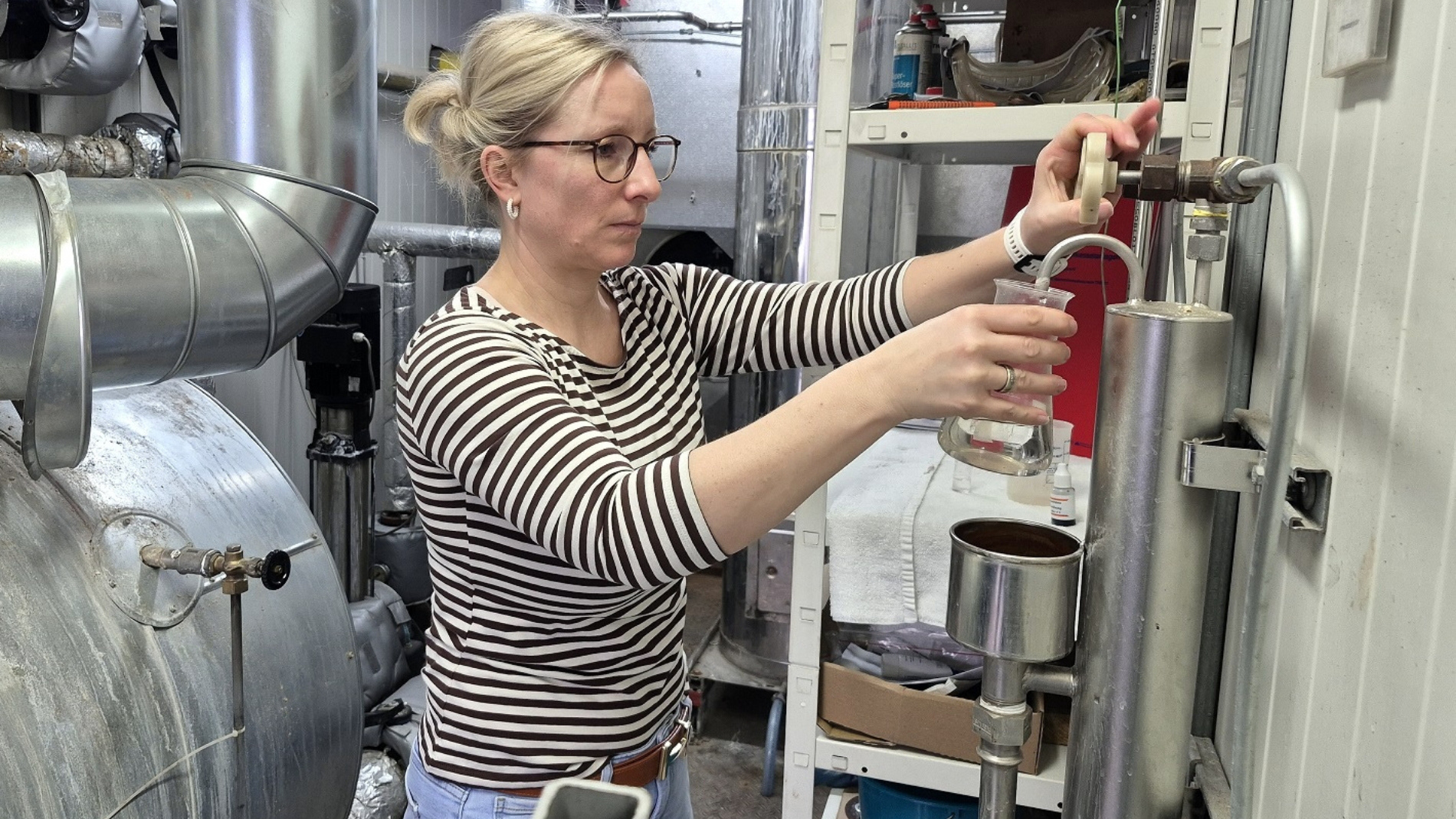
To finance the purchase, Perski and his wife Carina – whom he met through geocaching – go “all in,” as he puts it: “We sold our house and liquidated all our savings.” It’s the proverbial leap into cold water – one that also involves sacrifices for their son Finn, who has to change schools. Carina Perski, who has a commercial background, now works part-time in the business. She looks after the proper condition of the process water and boiler maintenance, keeps an eye on data security, and is currently training for her forklift licence. “As I said: a family business,” Perski says with a laugh.
120 Customers – All Ears
Around 20 years after entering the textile care industry, Perski is now his own boss, responsible for around 70 employees. Customer relations are also part of his day-to-day work. To get to know Wäscherei Reinhardt’s existing clients better, he visits them in person. His goal: to see every customer in the first year. “Out of 120, I’ve already managed 117,” he says. He attends the first four appointments alongside Reinhardt, then continues on his own. “I go there, introduce myself – and bring a good set of ears.” Perski asks: What can we do better? What have you always wanted? Where do you want to go from here? He also shares his own plans for the future. One customer reacts cautiously, essentially saying: Wäscherei Reinhardt positions itself in the market through its pricing, as does the competitor – and then they will see. It’s exactly the kind of directness Perski appreciates in the textile care industry. He takes on the challenge and, as he puts it, does his “homework”. A year later, the customer says: “We don’t want the cheapest – we want you, because you do good work.” For Perski, it’s confirmation that he’s on the right track.
It’s All About Teamwork
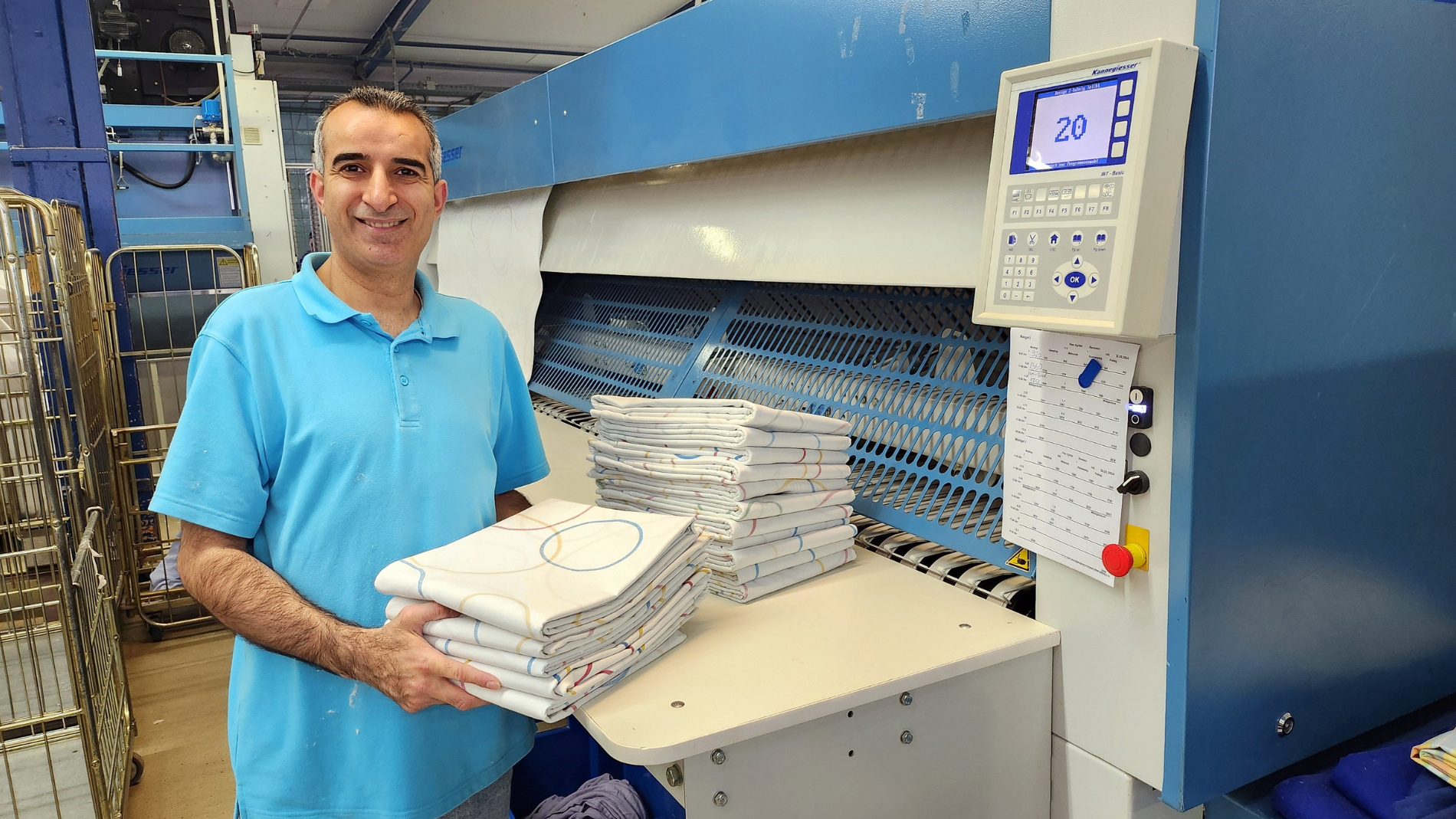
He attributes this success above all to his team: “We have a really strong and courteous team here.” Keeping that team together and motivated is key for Perski. That also means bringing along employees who have been with the company for decades. When a new shirt-finishing machine is met with scepticism, Perski steps in and works on it himself, showing how much easier it makes the job. “Wow, that’s actually really fast,” comes one reaction from the workforce. “No one here is better or worse than anyone else,” says Perski—and he means it. When a customer—a hospital that usually washes its own mop heads—has a machine breakdown and asks if he can step in, Perski replies: “Of course, send them over.” He adds: “What’s wrong with the machine? I could be there in 20 minutes and take a look.” On site, he finds a faulty limit switch that isn’t triggering the drain to open—a minor issue. Ten minutes later, the machine is running again. When Perski invites two students, who come in twice a week in the evenings to clean the laundry, to the company Christmas dinner, they are surprised: “We’re allowed to come?” Perski replies: “Of course! Do you know what your work contributes here? Clean machines run more smoothly, cause lower maintenance costs, and break down less often.”
“That Sweater Is Sacred to Us”
Perski also visits senior care homes, for which he handles the laundry. There, he gives talks to relatives to show them what goes on behind the scenes in a laundry. “Often, there are people who may have lost all their friends, whose family rarely or never visits – and then there’s that one sweater: 50 years old, washed 300 times, falling apart at the slightest touch, yet holding so many memories,” he explains. “When that sweater comes to us, it’s sacred to us.” This is a philosophy of textile care that Perski promotes wherever he can – for example, at training and career fairs.
“That’s the Wool Scream!”
To inspire young people to join the textile care industry, Perski gets creative. “Between corporations, retailers, banks, and companies that already tempt entrants with company cars, we have to come up with something different.” His approach: if there’s a queue at a neighbouring stand, he calls out, “Come over here while you wait, and I’ll tell you about textile care.” Many parents accompanying their children initially wave him off: “Laundry? My child won’t do that – I do that at home, and it’s no fun.” That’s Perski’s cue: “Do you know what detergents you need?” he asks. “One for light colours and one for dark?” He slowly warms up: “And wool? It always gets ruined, right?” – “Well, it always feels scratchy.” Now he has them: “That’s the Wool Scream!” – “The Wool Scream?” – “Yes, the Wool Scream! Wool screams because it has been tortured by improper washing.” Many then come over – and leave with a new perspective on textile care. What seems like a performance is actually hard work. “Training fairs are the toughest days of the year,” says Perski. “But there’s no way around it – today, companies have to market themselves to young people, not the other way around.”
Starting Without a Journeyman, Rising With Drive
Perski would ideally like to train apprentices himself, but even he struggles to find people. “I’m desperately looking for young leaders, but it’s incredibly difficult.” He also engages beyond his own business to support the next generation, examining journeymen and master craftsmen at the Anni Albers School, serving for years on the Training and Education Committee of the German Textile Cleaners Association (DTV), and contributing to the revision of the master craftsman exam regulations. “I want to work with the future stars of the industry,” says Perski, entirely seriously. Wherever possible, he encourages apprentices, telling them: “Do you know a huge advantage in our industry? You don’t need a journeyman certificate to start – unlike electricians or many other trades.” Perski translates it for young people: “If you start with training and have the drive, you can make your path in textile care.”
Hospitals Can’t Run Without Laundries
To raise the visibility of the industry—which, despite being systemically essential, is often overlooked—Perski is active in the Textile Services Southwest Association and has been its deputy chairman since 2024. “You pick up bread at the bakery, the electrician comes to your home, the building cleaner is the facility manager—but nobody knows the textile cleaner. Yet they keep the healthcare sector running,” Perski emphasises. The dependence of hospitals on textile care becomes clear in the detailed contingency plans laundries must submit when negotiating new contracts. “We have to clearly show which partners can provide capacity in an emergency, if our washing line goes down for a day, a week, or even a year,” Perski explains. “This ranges from minor breakdowns, where a single component fails but can be replaced the same day, to life-threatening disasters like a laundry fire, which can have consequences lasting years.” In dealing with complex contracts, his law background still comes in handy today: interpreting statutes, understanding heating plans, reviewing contracts, and navigating conditional language. “You learn how to extract the key content from texts.” Perski has never regretted trading the courtroom for the washing line. “In textile care, I found exactly what I wanted,” he says. “It was always my dream to own my own laundry—and looking back, it was the best decision I ever made.”
Brief profile
Wäscherei Reinhardt GmbH
Wäscherei Reinhardt in Wetzlar (Hesse) is a family-run business specialising in professional textile care and full-service laundry. Since its founding in 1952, the company has supplied senior care facilities, hospitals, industrial companies, and hotels with resident-specific laundry, flat and dry laundry, and workwear, optionally available through a rental system.