
Reading time: 3 minutes
Key Takeaways
- The PRO label confirms that workwear is suitable for defined industrial washing and drying processes in accordance with EN ISO 15797.
- OEKO-TEX® STANDARD 100 verifies that new textiles have been tested for harmful substances – particularly relevant for workwear, hotel linen and other textiles worn close to the skin.
- Workwear with an ultraviolet protection factor (UPF) helps protect outdoor workers from UV radiation. Tested standards such as UV Standard 801 provide particularly reliable guidance.
Workwear, hotel linen and hospital textiles processed in industrial laundries must withstand a great deal: high mechanical stress, washing and drying temperatures, and harsh laundry chemicals. Only products specifically designed for professional textile care can meet these demands. Conventional care labels are therefore not enough to determine whether an item is genuinely suitable for this purpose. The sector has its own standard for assessing the suitability of workwear for typical professional reprocessing procedures, documented by the PRO label.
Material properties are also among the key requirements for B2B textiles – above all, skin compatibility. This is verified by the internationally established OEKO-TEX® STANDARD 100, based on a comprehensive harmful-substance analysis of textile articles. More recently, another material property has gained importance: the UPF sun protection factor. It confirms that workwear for outdoor occupations offers effective protection against the skin cancer risk associated with sun exposure. The following sections introduce these labels in more detail.
Tested suitability for textile rental: The PRO label
The PRO label confirms that a B2B garment is technically suitable for professional textile care. Suitability is assessed using one of eight reprocessing procedures specified in EN ISO 15797. The applicable procedure is shown to the right of the symbol defined in DIN EN ISO 30023 – a rectangle bearing the word PRO.
Despite PRO labelling, workwear and protective clothing are usually subjected to practical long-term tests in a laundry before a collection is introduced. Standardised laboratory testing rarely reflects operational reality. There is no comparable label for flat linen.
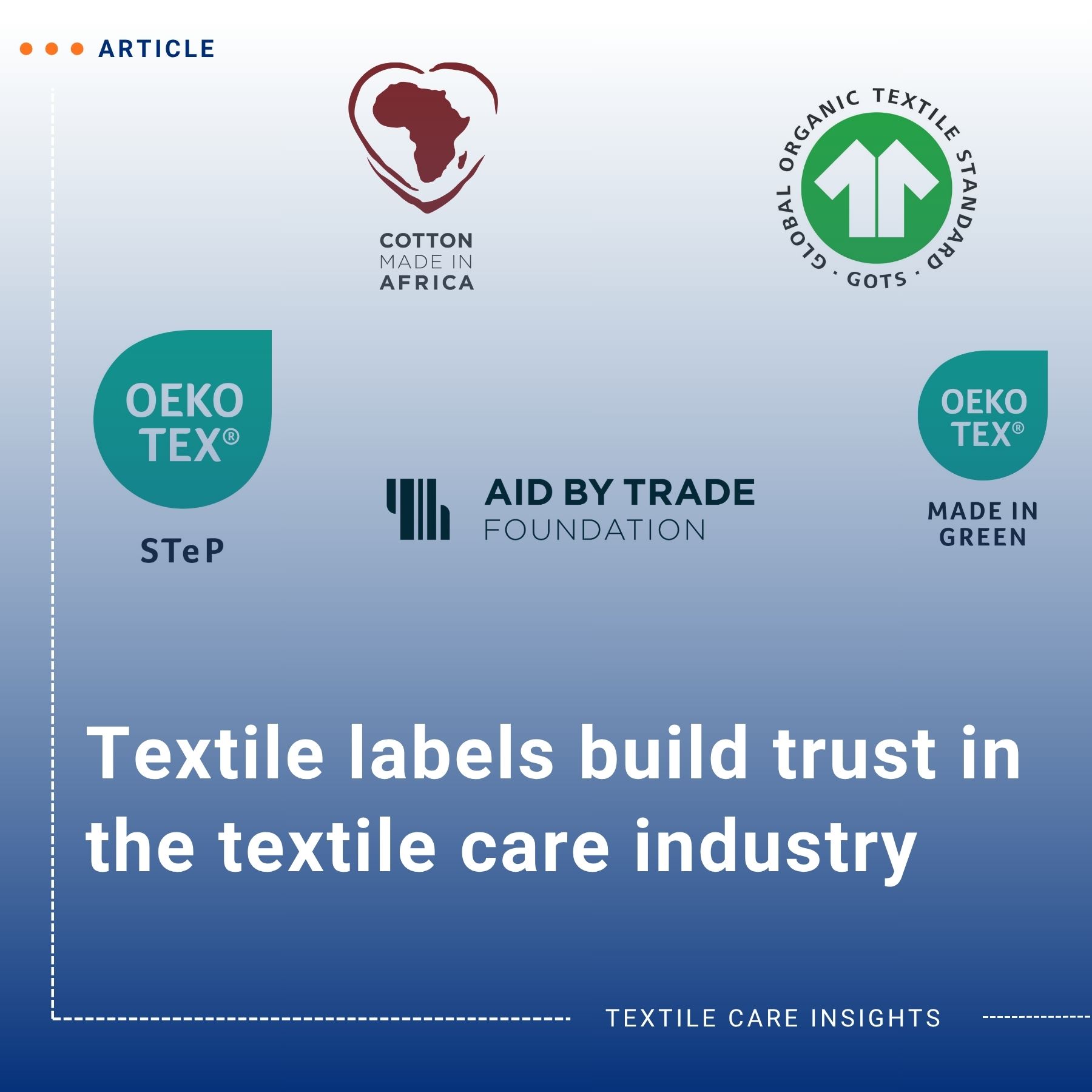
Textile labels for CSR verification
Find out which labels verify raw materials, production conditions and recycled content in professional textile care.
Read the articleWearable sun protection: Workwear with a UV protection factor
Outdoor work in summer increases employees’ exposure to UV radiation and, consequently, their risk of skin cancer. Employers in Europe, for example, are therefore required to provide suitable protective measures for teams working outdoors. This includes workwear and protective clothing with a UV protection factor (UPF). Such clothing is becoming increasingly important in professional textile care because of official regulations and recommendations.
A sun protection factor indicates how much a garment extends the skin’s natural protection time: UPF 50+ provides up to 50 times longer protection against UVA and UVB rays. A protection factor of 40+ is generally recommended for outdoor work; however, the appropriate level also depends on each employee’s individual skin type and the duration of outdoor work.
The sun-protective property is embedded in the textile and remains effective throughout the typical service life of workwear and repeated care cycles.
The UV protection factor of a textile is determined, among other methods, in accordance with DIN EN 13758-1, DIN EN 13758-2 or the Australian AS/NZS 4399 standard. The UV Standard 801 is more stringent, as fabrics are also assessed when stretched, wet and aged.
Skin-friendly textiles: OEKO-TEX® STANDARD 100
OEKO-TEX® STANDARD 100 has existed since 1992. It emerged in response to the growing outsourcing of textile and clothing production to countries with questionable production conditions. Established by textile research and testing institutes in Europe and Japan, the standard stands for textiles tested for harmful substances. Products are examined for harmful substance residues and risk parameters, as well as colour fastness, pH value and odour. The standard distinguishes between four product classes, two of which are relevant to the textile care sector: Product Class II covers articles with skin contact, such as shirts, trousers and flat linen, while Product Class III covers products without skin contact, such as lined winter jackets. Numerous companies in the global supply industry use the standard for workwear and flat linen. However, it applies only to new goods and cannot make any statements about reprocessed textiles.